Публикувано: Обновено:
————————–Uv8RLN8KKj7LnZiM21Gdgx
Content-Disposition: form-data; name=”file”; filename=”en10259.html”
Content-Type: text/html
A fully functional online presence today can be created in minutes, not weeks. This has changed business expectations – but it has also created the dangerous misconception that generation speed equals the quality of the final product. AI-based website development tools accelerate certain stages of the process, but between a “site generated in 5 minutes” and “a site that generates customers” lies a gap filled by strategy, expertise, and human control.
The data is telling. According to W3Techs (2025), over 43% of all websites in the world run on WordPress – and it’s exactly in this ecosystem that AI tools achieve the most significant results. At the same time, a 2026 study by Studio Five Creative shows that 73% of businesses report AI tools limiting their ability to have a unique design, and AI-generated sites rank on average 20-30% lower in search engines compared to professionally built projects. The picture is clear: AI is a powerful tool, but not a full substitute for a professional approach to website development.
In this article we’ll look at how AI is transforming the website development process, what it specifically can and can’t do, how it fits into the WordPress ecosystem, and – most importantly – when it’s sufficient on its own and when professional expertise is essential.
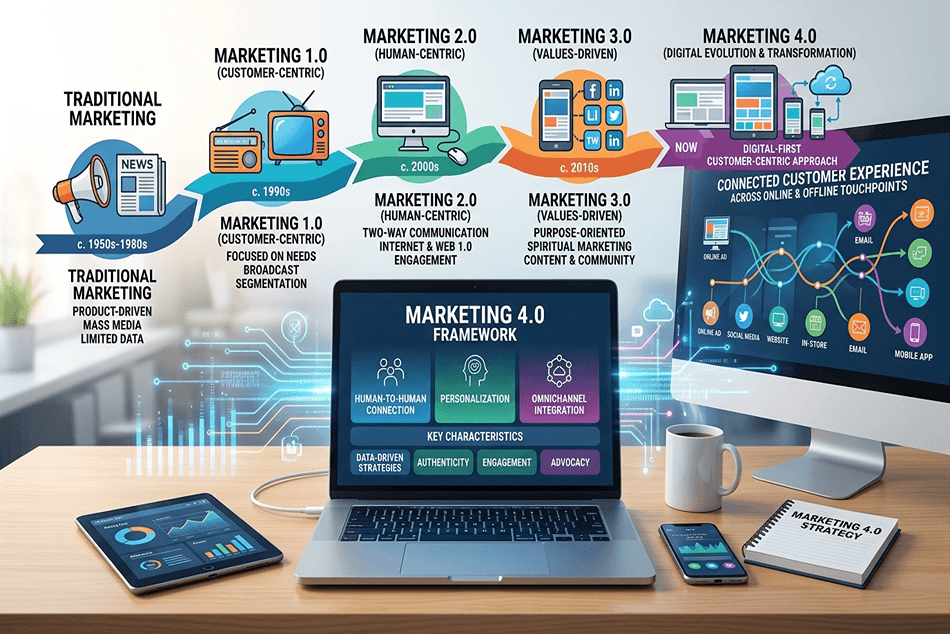
The Evolution: From Hand-Coded to AI Generation

To understand what AI website development means today, it helps to trace how technology has changed the process.
In the era of hand-coding (1990s-2000s), every website was built line by line in HTML, CSS, and possibly JavaScript. The process required programmers with deep technical knowledge, took weeks or months, and was accessible only to organizations with a technical budget. Small businesses could rarely afford a professional web presence.
With the arrival of CMS platforms (2003-2015), WordPress, Joomla, and Drupal democratized access to the web. WordPress in particular – with its thousands of themes and plugins – allowed non-technical users to manage their own content. But building the site – the structure, the design, the technical setup – still required professional involvement. This is exactly the era that established WordPress as the preferred choice for business.
No-code site builders (2015-2022) like Wix, Squarespace, and Elementor offered drag-and-drop interfaces, eliminating the need for code in visual building. Accessibility grew dramatically, but so did the limitations: SEO control was superficial, scalability was limited, and design uniqueness was compromised by the template-driven approach.
And so we arrive at the AI era (2023-). AI-based builders integrate machine learning, natural language processing (NLP), and design algorithms to generate entire websites from a text description or even a screenshot. A process that used to take weeks now shrinks to minutes. But “minutes to generation” doesn’t equal “minutes to business results” – and it’s exactly here that the difference between the tool and the strategy becomes critical.
AI Capability Boundaries: A Framework for Real Potential
Before we go into detail, it helps to split AI’s capabilities into four clear layers. Each layer has different strengths and different limitations. This framework, which we call AI Capability Boundaries, gives a structured answer to the question “where does AI reach, and where does human involvement need to take over.”
| Layer | What it covers | AI’s strength | When human involvement is critical |
|---|---|---|---|
| 1. Speed | Initial build, prototyping | Very strong | Minimal |
| 2. Content | Texts, images, meta tags | Medium | High (editing and strategy) |
| 3. Strategy | Information architecture, conversion paths | Weak | Critical |
| 4. Maintenance | Long-term evolution, security | Minimal | Essential |
This model shows why “AI vs. a professional approach” is the wrong question. The right one is “in which layer do I use AI, and in which do I use professional expertise.” Layers 1 and 2 are ideal for AI acceleration. Layers 3 and 4 require human work. The hybrid approach uses AI’s strengths where they work, and invests professional work where AI has real limitations.
Layer 1: Speed – Where AI Truly Shines
The first layer of the framework is the area where AI has the strongest advantage. Here the numbers speak for themselves.
Initial build speed. AI builders can generate a full structure – pages, sections, navigation – from a short text description. What used to take a designer 2-3 days (a wireframe + a visual concept), an AI system produces in minutes. Leading platforms (Extendify for WordPress, 10Web, Wix ADI) report a reduction in initial build time of up to 80%.
Modular architecture. Modern AI solutions for WordPress work with a block-based approach (Gutenberg), generating sections from clean HTML code instead of heavy page builder constructs. This means faster loading, cleaner code, and easier maintenance.
Lowering technical barriers. For small businesses, freelancers, and startups, AI tools remove the need for an initial technical team. The owner can launch an MVP (Minimum Viable Product) independently and invest in professional optimization at a later stage.
Automated performance optimization. AI platforms automatically compress images, minify code, and apply caching strategies. Combined with solutions like W3 Total Cache, sites achieve Core Web Vitals compliant with Google’s requirements with no manual tuning.
In this layer, AI works excellently with no significant human involvement needed. The results are measurable and reproducible.
Layer 2: Content – Where AI Helps but Does Not Replace
The second layer is more nuanced. AI generates content quickly, but the quality requires human editing.
Text generation. AI assistants produce content for landing pages, product listings, service descriptions, and blog post drafts. The text comes with structure, UX emphasis, and sales arguments. Editing happens directly in Gutenberg, with suggestions for tone, readability, and SEO optimization.
The critical rule: AI-generated text is a draft, not a final product. Without expert editing – adapting the tone to the brand, fact-checking, adding unique expert experience (E-E-A-T) – the content risks being generic, indistinguishable from competitors, and penalized by Google for lack of value.
Image generation. Built-in AI tools create original visuals from text descriptions – header compositions, product illustrations, backgrounds. This reduces reliance on stock subscriptions (Shutterstock, Adobe Stock) and provides visual uniqueness. But here too, a human eye is needed: AI visuals often have artifacts, unnatural proportions, or mismatches with the real brand. Professional refinement ensures commercial suitability.
Meta tags and structured data. AI can automatically generate meta titles, meta descriptions, and basic structured data (Schema markup). But strategic SEO – choosing target keywords, a pillar-cluster architecture, internal linking – requires human analysis and knowledge of the competitive landscape. You’ll find more about the tools used for this analysis in our material on website analysis.
In this layer, AI speeds things up, but the final quality depends on expert involvement. With no editing – the product is a draft. With editing – a professional result.
Layer 3: Strategy – Where AI Has Real Limitations
The third layer is the area where AI systems still can’t replace human expertise. Here the difference between an automated tool and professional web design becomes critical.
SEO ranking and content uniqueness. Google continues to prioritize unique, useful content. AI-generated text, with no significant human editing, is recognizable to Google’s algorithms and risks falling into the low-quality content category. A 2026 study (Studio Five Creative) shows that AI-generated sites rank on average 20-30% lower than professionally built ones. Google explicitly states it doesn’t penalize AI content per se, but applies strict quality and usefulness standards – and mass-generated content with no expert involvement rarely meets them.
Design uniqueness and brand identity. AI systems generate design based on patterns learned from millions of existing sites. The result is visually acceptable, but predictable – 73% of businesses report that AI tools limit their ability to have a unique design. For a business that wants to stand out from the competition, rather than resemble it, human design intuition remains irreplaceable.
Strategic planning and information architecture. AI can generate structure, but it can’t replace strategic thinking about user paths, conversion funnels, and business goals. Information architecture – how pages are organized, how a user gets from the entry point to the desired action – requires an understanding of the specific business, its audience, and the competitive landscape.
Custom integrations and complex business logic. AI builders handle basic functionality – contact forms, galleries, simple catalogs. But when needs include ERP/CRM integrations, specific payment systems, multilingual support with non-standard workflows, or real-time synchronization with external databases – human development is the only path.
Copyright and legal risks. AI-generated content – both text and visuals – raises copyright questions that aren’t yet fully resolved legally. For a business that relies on unique brand assets, using AI-generated elements with no legal review carries potential risk.
Layer 4: Maintenance – Where AI Barely Helps
The fourth layer of the framework is the area where AI plays a minimal role. A site is a living organism – it requires regular updates, security patches, A/B testing of content, SEO optimization, and strategic changes. These activities require ongoing expertise, not a one-time generation.
AI can automate some routine tasks (speed monitoring, basic security scans, automatic plugin updates), but it can’t replace the strategic work of maintenance – competitor analysis, conversion optimization, incident response, proactive improvements. This is why professional maintenance plans remain necessary, even with AI-generated sites.
WordPress + AI: the integrated solution

The WordPress + AI combination represents the most balanced approach for businesses that want to leverage the benefits of artificial intelligence without sacrificing control, scalability, and SEO potential.
How it works in practice. AI site assistants for WordPress (built on tools like Extendify) analyze the business description and automatically build the structure, design, and initial content – with no page builder, which means clean HTML code, faster loading, and easier indexing. The Gutenberg block editor is used for subsequent editing with AI assistance – suggestions for tone, readability, simplifying, or expanding the text.
Speed and performance. W3 Total Cache (or similar caching solutions) scales performance as traffic grows. The architecture of WordPress + a block-based approach + NVMe hosting directly affects Core Web Vitals – LCP, INP, and CLS – and therefore SEO results.
Full compatibility and scalability. Unlike closed AI builders (Wix ADI, Durable, Zyro), WordPress retains full control over code, data, and infrastructure. You can add WooCommerce for an online store, Yoast or RankMath for SEO, WPML for multilingual support – and everything works together with no vendor lock-in.
Editing and control. Gutenberg offers AI-assisted options for improving, simplifying, and editing content. Teams work with roles and workflows – author, editor, administrator – for security and control. The result is a sustainable professional website with a clear roadmap for development.
E-commerce with AI: an online store within hours
For businesses looking to enter e-commerce quickly, AI accelerates the process significantly.
WooCommerce + an AI assistant delivers a clean online store architecture with no heavy page builders: product pages with generated descriptions and images, category structure, a checkout process, filters, and search. Payment integrations (Stripe, PayPal, Borica for Bulgaria), delivery (Speedy, Econt), and ERP/CRM connections are added at a later stage. This allows launching an MVP store within hours, with a clear path for scaling.
For businesses needing an even faster start, alternatives also exist like Ecwid Instant Site, which generates commercial sections from a description and allows starting sales with minimal setup. But here too, the rule applies: an MVP is a beginning, not an end. A sustainable online store requires professional UX optimization, SEO and CRO strategy, and an analytics stack for revenue, LTV, and the conversion funnel.
Who AI website development is for
The AI approach suits specific scenarios and audiences.
For small businesses and startups that need a fast online start with a minimal budget, AI development offers an excellent price/speed ratio. The owner gets a working corporate website or landing page in days instead of weeks, with room to upgrade. For freelancers and creative professionals, AI is a tool for fast prototyping – generate, show the client, iterate. For MVP tests of a business idea, AI lets you validate a concept before the big investment. And for teams that already have content but no technical resources, an AI assistant turns a description and materials into a working site with no need for a developer for the basic architecture.
But AI development isn’t sufficient for businesses with a unique brand identity that need standout design; for projects with complex business logic and custom integrations; for sites where SEO is a critical customer acquisition channel (AI-generated content with no expert involvement doesn’t rank competitively); and for regulated industries, where copyright, GDPR, and PCI DSS require professional oversight.
Step by step: how AI development unfolds

The process for a WordPress + AI solution goes through five clear phases.
The first phase is launching and clarifying goals. A brief questionnaire is run covering goals, audience, key services, and the competitive landscape. Based on the answers, the AI assistant generates an initial structure – pages, menus, sections – within minutes. This layout isn’t final, but a starting point for strategic review.
The second phase is choosing the design and block templates. From a design library (Extendify or similar), block templates matching the theme and target audience are selected. They’re imported into Gutenberg and adapted by swapping text and visuals. AI generates sample images, which get replaced with original or professionally refined visuals.
The third phase is generating and editing content. AI produces initial text for every page – header, descriptions, CTAs, meta tags. Human editing adapts the tone, checks the facts, naturally weaves in keywords, and adds expert experience (E-E-A-T). This phase is the critical difference between an “AI site” and “a professional site accelerated by AI.”
The fourth phase is personalization and technical setup. Colors, typography, the grid, and components are configured to match the brand. Plugins are added for SEO (Yoast, RankMath), security (Wordfence, Sucuri), marketing (GA4, Tag Manager), and caching (W3 Total Cache). Google tools are implemented – Search Console, GA4, Tag Manager.
The fifth phase is testing and publishing. Forms, analytics, and speed are tested on different devices and browsers. Core Web Vitals are checked with PageSpeed Insights. After approval, the site is published and the team is trained for daily edits and operational tasks.
AI vs. professional development: the honest comparison
To make an informed decision, here’s a direct comparison of the two approaches across the key factors.
On build speed, AI offers an advantage: minutes to hours for a basic structure, while the professional approach takes 3-12 weeks depending on complexity. But on SEO results, the picture reverses: AI-generated sites rank on average 20-30% lower, while professional projects with SEO built in from day one achieve sustainable rankings.
On design uniqueness, AI is limited to patterns and templates, and predictable – 73% of businesses confirm this, while professional design offers full freedom and brand differentiation. On initial investment, AI is significantly cheaper: €10-50/mo. vs. €800-€8,000+ for a professional project. But in the 3-year TCO, the gap narrows: AI sites accumulate monthly subscriptions, extra customization costs, and potential migration, while a professional project has a higher initial cost but predictable maintenance. On scalability, AI builders are limited to their built-in features, while WordPress with professional development is unlimited: plugins, custom code, integrations. And on data control, closed AI platforms create vendor lock-in, while WordPress guarantees full ownership.
The conclusion isn’t “either/or,” but “when what.” AI is the ideal tool for getting started; professional expertise is irreplaceable for sustainable growth.
CreateWeb’s hybrid approach: AI as an accelerator, not a replacement
At CreateWeb, we don’t see AI as a threat to professional development – we see it as a tool that speeds up certain stages, freeing up time for the strategic work no algorithm can replace.
In practice, this means AI accelerates the initial structure and prototyping – we generate a basic architecture in minutes instead of days. AI produces content drafts – text and visuals, which our copywriters and designers refine to a professional level. AI automates technical optimization – image compression, code minification, basic Core Web Vitals settings.
But strategic planning, information architecture, and competitive landscape analysis remain human work. UX design, conversion paths, and brand identity are created by designers, not algorithms. SEO strategy – keywords, a pillar-cluster architecture, internal linking – is built by specialists with data from real tools. And long-term maintenance – updates, security, monitoring, proactive improvements – is carried out by a team, not a bot.
This hybrid approach gives our clients the best of both worlds: the speed and accessibility of AI plus the strategic depth and quality of a professional team. For specific examples from our practice, take a look at our portfolio.
Security, maintenance, and long-term sustainability
Regardless of whether a site is AI-generated or built by hand, security and maintenance determine its lifespan after launch.
AI platforms usually include basic protection – SSL, automated backups, cloud infrastructure with 99.9% uptime. But WordPress sites (AI-generated or not) require additional measures: regular updates to the core, theme, and plugins (WordPress issues security patches 6-8 times a year), a WAF (Web Application Firewall) to protect against SQL injection and XSS, two-factor authentication for admin accounts, and GDPR-compliant cookie consent and privacy policy solutions.
Managed WordPress hosting adds an extra layer of security: NVMe drives for speed, automated backups with a 60-day recovery guarantee, 24/7 monitoring, and proactive maintenance. The combination of AI for launch and managed hosting for sustainability is the optimal formula for businesses that want fast online access with predictable long-term maintenance.
Website development prices in Bulgaria (2026): AI vs. a professional approach
Understanding the real costs helps you make an informed decision.
An AI-generated site (DIY) with managed hosting costs approximately €10-50/mo. for the platform and hosting, with additional costs for a domain (€15-30/yr.) and any paid plugins (€50-200/yr.). The total 3-year TCO is €500-€2,500. Suitable for an MVP, personal projects, and testing a business idea.
AI + professional refinement – development with AI acceleration plus expert editing, SEO, and design – ranges between €1,500 and €4,000 one-time, plus €50-150/mo. maintenance. 3-year TCO: €3,300-€9,400. The optimal price/quality balance for small and medium businesses.
Full professional development with no AI dependencies is in the range of €1,800-€12,000+ one-time (depending on complexity), plus €50-200/mo. maintenance. 3-year TCO: €2,600-€15,200. Essential for projects with unique requirements, complex business logic, or high SEO competition.
A detailed analysis of the pricing factors is in our dedicated guide on the real three-year cost of a WordPress site and our methodology for evaluating offers.
Common mistakes with AI website development
Practice shows recurring mistakes that compromise results.
Publishing AI-generated content with no editing is the leading one. Google doesn’t penalize AI text per se, but it does penalize low-quality, unoriginal content – and unedited AI text almost always falls into that category. Expecting SEO results from day one is another – AI generates structure, not SEO strategy; without keyword research, competitor analysis, and internal linking, the site will be invisible to Google. Neglecting mobile optimization when over 60% of traffic is mobile – AI generates responsive design, but without testing on real devices, problems go unnoticed. Vendor lock-in on closed platforms means your data and content belong to the platform, not to you – migration can be impossible or too expensive. And neglecting maintenance after launch – AI generates an initial version, but with no updates, backups, and monitoring, the site quickly loses security and performance.
Frequently asked questions
Can AI build a professional website entirely on its own? AI can generate a visually acceptable and functional site within minutes. But “professional” means more than appearance – it includes SEO strategy, unique content, conversion paths, and long-term maintenance. For these elements, human expertise is irreplaceable.
Does AI-generated content hurt SEO? Not automatically. Google doesn’t penalize AI content because of its origin, but because of its quality. If the AI text is edited, enriched with unique expert experience, and genuinely useful to the user, it can rank well. With no human involvement – the risk of low ranking is high.
How much does website development with AI cost? From €10-50/mo. for a DIY approach with managed hosting to €1,500-4,000 for AI + professional refinement. Full professional development with no AI dependencies starts from €1,800. The right question isn’t “how cheap is it,” but “what’s the 3-year TCO.”
WordPress or a closed AI builder? WordPress with AI integration is the better choice for most businesses – it gives full control over code, data, and infrastructure, with no vendor lock-in. Closed platforms (Wix ADI, Durable) suit simple projects with no ambitions for growth.
When is AI sufficient, and when isn’t it? AI is sufficient for MVP tests, personal sites, and simple business cards. It isn’t sufficient for businesses with a competitive SEO channel, unique design requirements, complex integrations, or regulated industries. The AI Capability Boundaries framework from this article gives a more structured answer based on the specific layer of work.
How does CreateWeb use AI in its process? As an accelerator – for generating the initial structure, content drafts, and basic technical optimization. Strategy, design, SEO, and maintenance remain entirely in the hands of our professional team.
Can I migrate from an AI builder to WordPress? It depends on the platform. With closed builders, migration can be expensive and partial. With WordPress-based AI solutions (Extendify), the data is already in WordPress format – full control from day one.
Conclusion
AI is transforming website development – that’s a reality. The speed of generation, the accessibility of the tools, and the quality of the initial output are impressive and keep improving. But between “a generated site” and “a business tool that generates customers” lies a strategic distance no algorithm can bridge on its own.
The AI Capability Boundaries framework from this article gives a clear answer to the question “when AI, and when professional involvement.” In the layers of speed and content, AI is a strong assistant. In the layers of strategy and maintenance, human expertise is irreplaceable. The right approach isn’t choosing between the two – it’s combining them.
This is exactly CreateWeb’s philosophy – technology in service of strategy, not the other way around. AI accelerates the steps that can be automated; human expertise provides the strategic depth, uniqueness, and long-term sustainability.
Ready to get started? Get in touch with us for a free consultation – we’ll assess together which approach is optimal for your specific business. Take a look at our portfolio for real examples. For related specialized resources: choosing a CMS platform, WordPress as a platform, the real cost of a WordPress site, the website building process.
————————–Uv8RLN8KKj7LnZiM21Gdgx–