
Публикувано: Обновено:
Most owners of small and medium-sized businesses in Bulgaria have heard that they “should be doing content”. The problem is not motivation but a lack of clarity. What does “content” actually mean? What is its business purpose? And how do you get from a concept that sounds abstract to a concrete system that generates customers?
The figures give a clear answer: content marketing produces 3 times more leads than traditional outbound marketing at 62% lower cost. Companies with an active blog get 67% more potential customers per month. And the global content marketing industry is already worth 487 billion dollars in 2026, with an expected annual growth rate of 14.3% (according to industry sources such as the Content Marketing Institute).
This article from the CreateWeb team is a practical guide, from the definition of “content” to a working content strategy for a small business. It explores in depth one of the channels we presented in our overview of digital marketing. We will also introduce the Content Strategy Stack, a 5-level framework running from goals to measurement, and finish with the most important yet often overlooked step, the technical foundation: your website.
What Is Content – Definition and Meaning

The word “content” literally means “what something contains”. In the digital context, content is any purposefully created information intended for a specific audience. This includes text (articles, blog posts, guides), video (reviews, explainer videos, livestreams), images (infographics, illustrations, photographs), audio (podcasts, audio versions of articles) and interactive elements (calculators, tests, quizzes).
The meaning of content in a business context goes beyond “publishing something on the blog”. Content is the means by which a business answers potential customers’ questions, demonstrates expertise, builds trust and guides the audience from awareness of a problem to a purchase decision.
Google is central to this meaning. The search engine prioritises helpful content: content that is genuinely useful to people, demonstrates real expertise and delivers a satisfying user experience (Google Search Central documents these principles in detail). The E-E-A-T framework (Experience, Expertise, Authoritativeness, Trustworthiness) determines which content deserves higher rankings. In 2026, content that leads with keywords but shows no demonstrated experience is actively suppressed in results. We have a separate guide on E-E-A-T and how to demonstrate it through content.
So the meaning of content boils down to one simple equation: useful content + technical foundation = visibility in Google = customers.
Content Strategy Stack: A Framework for Content Strategy
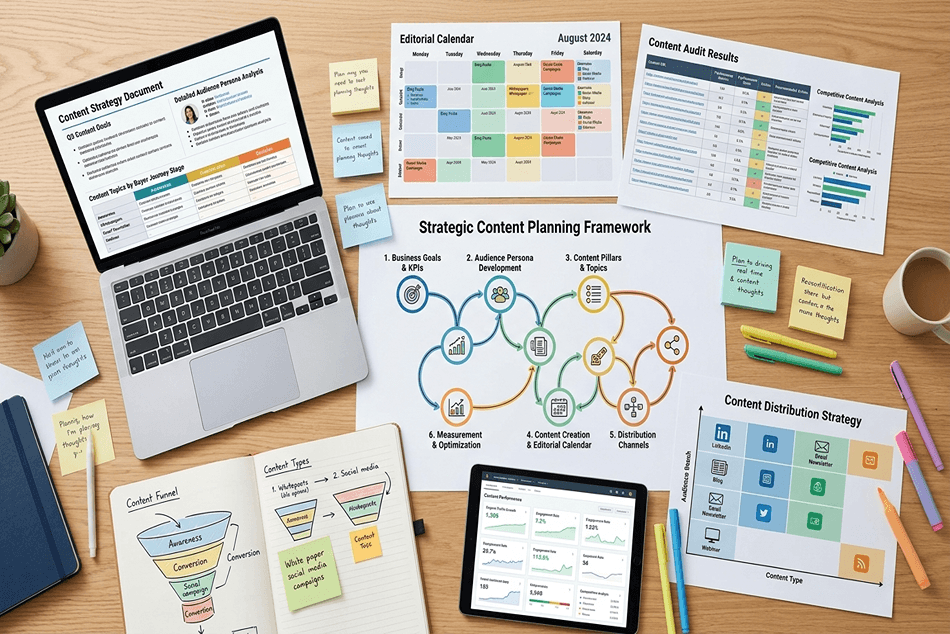
One of the most common mistakes in content marketing is jumping straight into writing, “let’s write a few articles”, with no goal, no audience and no plan for measurement. The result is wasted resources and zero measurable effect. This framework, which we call the Content Strategy Stack, organises content strategy into 5 levels, each built on the one before.
| Level | What it covers | Without it |
|---|---|---|
| 1. Goals | 1-2 business goals (traffic, leads, awareness) | Content without direction |
| 2. Audience | Target audience, keywords, questions | You write for the wrong people |
| 3. Format | Formats and channels (blog, video, email) | The wrong format for the wrong stage |
| 4. Calendar | Content calendar, consistency | Sporadic publishing, then silence |
| 5. Measurement | KPIs, GA4, Search Console, adaptation | You do not know what works |
The principle of the stack: each level feeds the next. Goals (Level 1) determine what you write for. Audience (Level 2) determines who for. Format (Level 3) chooses how. Calendar (Level 4) ensures consistency, the most important success factor. Measurement (Level 5) shows what works and closes the loop. Skipping Levels 1-2 (strategy) is the No. 1 reason content efforts fail.
Applying the framework: you build from the bottom up. First the goals, then the audience and keywords, then the formats, the calendar and finally measurement. 73% of B2B and 70% of B2C companies with a documented strategy generate significantly more leads than those without, because they follow exactly this sequence.
Content Marketing vs Advertising – Why Content Wins in the Long Run
Advertising (PPC, banners, sponsored posts) works on the model “you pay, they see you, you stop paying, you disappear”. Content marketing works the other way round: you publish, the content gets indexed, generates traffic and keeps delivering results for months and years ahead.
The 2026 data paints a clear picture. The average 36-month return on investment (ROI) of content marketing is 448%, including the accumulating value of evergreen content. SEO leads convert at 14.6% compared with 1.7% for outbound marketing. The average cost per lead from content marketing is $92 (B2B), versus $242 from paid search. Companies that publish consistently are 13 times more likely to see a positive return.
This does not mean advertising is useless – quite the opposite, it has an irreplaceable place for quick results and retargeting. But content marketing is the foundation, and advertising is the accelerator. Both require a well-designed website as the end point, because every click from Google, Facebook or Google Ads takes the user to your site.
Level 3 – Types of Content: What Works and When to Use It

Not every format suits every business. The choice depends on the audience, the budget and the goals. Here is what the 2026 data shows for the main formats.
Blog posts (long form). 92% of marketers use them. Posts over 2,000 words earn 77% more backlinks. The average blog post length in 2026 is 1,427 words, and posts over 3,000 words get 3.5x more backlinks. The blog remains king for SEO and lead generation: companies with an active blog have 434% more indexed pages. We have a dedicated guide on how to start a blog and make money from it.
Video. 91% of businesses use it as a marketing tool. Video has the highest engagement rate (72%) of all formats, and 88% of marketers say it delivers a positive return. Short-form video (Reels, Shorts, TikTok) is the leading format for investment in 2026.
Case studies. A medium level of engagement, but exceptionally strong for lead generation; 61% of marketers create them. 41% of B2B buyers consume 3-5 pieces of content before contacting the seller, and case studies are among the most persuasive.
Email newsletter. 78% of marketers use it for distribution, and email marketing has an ROI of 4,200%. But an effective newsletter requires sign-up forms and valuable landing pages on the website – infrastructure, not just creativity. We have a separate article on email marketing and automation.
Infographics. They get 3x more shares than text content and are a powerful tool for backlinks. 65% of marketers include them in their arsenal.
Interactive content. Calculators, quizzes and interactive guides hold the user for 4.1 minutes on average (versus 2.1 min. for static content) and convert 2x better. 34% of marketers already use them, a growing trend.
The key takeaway is that the format must match the stage of the customer journey: informational content (blog, video, infographics) attracts new visitors; mid-funnel content (case studies, guides, email) builds trust; bottom-funnel content (comparisons, demos, calculators) turns visitors into customers. All of this lives on your website.
Content Strategy Step by Step for a Small Business
73% of B2B companies and 70% of B2C companies with a documented content strategy generate significantly more leads than those without. For a small business, the strategy does not need to be a 50-page document; a working five-step plan that follows the levels of the Content Strategy Stack is enough.
Step 1 (Goals) – define business goals. Content marketing can serve different goals: more organic traffic, lead generation, brand awareness, customer education. Choose 1-2 primary goals; trying to cover everything at once spreads your resources too thin. According to 2026 research, the top three goals are increasing brand awareness (84%), generating leads (74%) and audience engagement (71%).
Step 2 (Audience) – research the audience and keywords. Who is your ideal customer? What questions do they ask? What do they search for on Google? Keyword research is the bridge between “I know what I do” and “I know how the customer searches for me”. Tools such as Google Search Console, Ahrefs, SE Ranking or even the free Google Keyword Planner provide clear data on search volume and competition. We have a separate guide on keyword research.
Step 3 (Format) – choose formats and channels. A small business with limited resources cannot do everything. Blog + email newsletter is the minimum combination with proven effectiveness: the blog attracts organic traffic, and the newsletter retains and converts it. 53% of all traffic comes from organic search, and email marketing has the highest ROI of all channels (4,200%). If you can do video, add it, but not at the expense of consistency.
Step 4 (Calendar) – create a content calendar. Consistency matters more than volume. Better 2 quality posts a month for 12 months than 10 posts in the first month followed by silence. The data shows that at least 6 months of consistent publishing are needed before measurable traffic growth, and companies that publish 16+ times a month get 3.5x more traffic than those that publish 0-4 times.
Step 5 (Measurement) – measure and adapt. 61% of marketers struggle to link content metrics to revenue. The minimum KPIs for SMEs are: organic traffic (Google Analytics / GA4), rankings for target keywords (Search Console), conversion rate (forms, calls, purchases) and engagement (time on page, scroll depth). Only 42% of marketers can prove content ROI, and those who can get a 3.1x larger budget increase. We have a dedicated article on marketing metrics.
The Role of the Website: “Step Zero” of Content Marketing

Here is an uncomfortable truth: you can create perfect content, but if the website is slow, unstable or poorly structured, the content will not work. The website is “step zero”, the technical infrastructure without which a content strategy fails.
Blog architecture. 43% of all websites in the world are built on WordPress, the platform that offers the most flexible blog architecture. The right structure includes: clear categories and tags (taxonomy), an SEO-friendly URL pattern (/blog/ime-na-statia/), breadcrumbs for navigation and internal linking between related articles. Companies with a blog have 434% more indexed pages and 97% more inbound links.
Speed and technical stability. Every additional second of delay increases bounce rate by 32%. If the site takes over 3 seconds to load, 53% of mobile users leave before reading a single line of your content. Core Web Vitals (LCP < 2.5 s, INP < 200 ms, CLS < 0.1) are not only an SEO factor but the foundation of the content experience. Fast hosting and technical maintenance are not “extra costs”; they are the foundation.
Heading hierarchy and on-page SEO. Google reads the structure of the page: H1 (title), H2 (sections), H3 (subsections). A correct heading hierarchy helps both the user and the search engine understand what the content is about. Combined with a meta description, image alt text and schema markup (Article, FAQPage), the page gains maximum visibility. How SEO and web design work together is something we know well, and the writing of these texts itself is the subject of SEO copywriting.
Mobile-first. Over 60% of web traffic is mobile. If your blog is not readable on a phone, you lose more than half your audience. Responsive design is not an option; it is a mandatory element of the content infrastructure.
CTAs and conversion elements. Content has to lead somewhere: to a form, a call, a purchase or a sign-up. Without clear call-to-action buttons, correctly positioned on the site, traffic from content remains a “vanity metric”: people who read and leave. Conversion rate optimisation turns content visitors into real customers.
The Bulgarian Context: What Works for Local Businesses
Bulgaria is a specific market with particular characteristics that affect content marketing.
First, competition for quality content in Bulgarian is significantly lower than in English. 7.5 million blog posts are published worldwide every day, but in Bulgarian this number is incomparably smaller. This means that well-written, SEO-optimised content has a real chance of ranking highly, something that takes months longer in the English-speaking market.
Second, users are increasingly searching Google in Bulgarian. Bulgarian keywords such as “content marketing” (70 searches/month), “content” (150) and “content meaning” (70) may look small in absolute terms, but given the high conversion rate of SEO traffic (14.6%), even 50 visits a month can bring in real customers.
Third, for many small businesses in Bulgaria, digital presence is still limited to a Facebook page. This creates an opportunity: businesses that invest in their own website with a blog gain a competitive advantage precisely because most competitors do not. The combination of a professional website and even a minimal content strategy can change a business’s position in Google within months.
AI and Content Marketing in 2026: Opportunities and Risks
67% of marketers already use AI tools daily in their content processes. AI significantly speeds up research, idea generation and first drafts; productivity rises by 12% on average, and content production costs fall by 30-40%.
But the data also shows the flip side. Purely AI-generated content (without human editing) ranks 23% lower on average after 12 months. 53% of content marketing leaders are concerned about quality control in AI-generated content. Google does not penalise AI content per se, but it suppresses content without E-E-A-T, without demonstrated experience, expertise and authenticity.
The right approach is AI as an assistant and a human as strategist and editor. AI generates the draft; a human adds experience, examples and brand tone and checks the facts. This hybrid model delivers a 2.4x better return than purely AI or purely manual production. We cover this debate in detail in our article on SEO copywriting.
For small businesses specifically: AI can solve the “I have no time to write” problem, but it does not replace the need for a strategy, a sound technical foundation and a website where the content can live.
How CreateWeb Prepares Your Website for Content Marketing
Our team’s role is to build and maintain the technical infrastructure on which content marketing will run. The analogy is simple: content is the fuel, and the website is the engine. Without a working engine, the fuel is useless.
In practice, this means: an SEO-optimised blog architecture with correct URLs, categories, breadcrumbs and heading hierarchy. Fast, stable hosting that keeps Core Web Vitals in the green zone. Mobile-first responsive design that makes content readable on any device. Schema markup (Article, FAQPage, HowTo) for structured data that increases visibility in the SERP. Setup of Google tools (GA4, Search Console, GTM) to measure content performance from day one. CTA elements, forms and conversion optimisation that turn content traffic into leads. Regular maintenance: updates to WordPress and plugins, security and speed, so the technical foundation does not become outdated.
If you need content (copy, visuals, brand identity), the specialists at wellConnected, the ecosystem CreateWeb is part of, can help.
Common Small Business Mistakes in Content Marketing
Publishing without a strategy. “Let’s write something” without a clear goal, a target keyword and a defined audience is a recipe for zero results. 73% of successful companies have a documented strategy, not because they love documents, but because a strategy provides direction.
Lack of consistency. The most common scenario: the business publishes 5 articles in the first month, 2 in the second and none in the third. Content marketing is “compound interest”; the accumulating value comes after 6+ months of consistent publishing. Before that, the results look disappointing and many businesses give up prematurely.
Content without a technical foundation. A perfect article published on a site that takes 6 seconds to load, has no mobile version and is not properly indexed by Google is invisible. A website analysis is the logical first step before you invest in content.
Ignoring internal links. Every new article should be linked to existing pages, and vice versa. Internal links create topical clusters, improve crawling and help Google understand the site structure. Isolated articles with no links are “orphans” in the eyes of the search engine.
No measurement at all. If you do not know how much traffic comes from the blog, which articles generate leads and what the conversion rate is, you cannot improve anything. Invest in setting up Google tools and track at least the core metrics from day one.
Frequently Asked Questions
What is content and what does content mean?
Content is any purposefully created information for a specific audience: text, video, images, audio, interactive elements. In a business context, the meaning of content goes beyond “publishing something”; content is the means by which a business answers customers’ questions, demonstrates expertise and guides them from awareness of a problem to a purchase.
What is the Content Strategy Stack and how is it applied?
It is a 5-level content strategy framework: Level 1 Goals (1-2 business goals), Level 2 Audience (audience and keywords), Level 3 Format (formats and channels), Level 4 Calendar (content calendar, consistency) and Level 5 Measurement (KPIs, GA4, adaptation). The principle: you build from the bottom up, and each level feeds the next. Skipping Levels 1-2 (strategy) is the No. 1 reason content efforts fail.
Content marketing or advertising – which is better?
It depends on the time horizon. Advertising delivers quick results, but traffic stops when you stop paying. Content marketing accumulates value: once indexed, content generates traffic for months and years. Content has a 448% ROI over 36 months and an average cost per lead of $92 (B2B) versus $242 from paid search. The ideal approach: content is the foundation, advertising is the accelerator.
How often should I publish content?
Consistency matters more than volume. At least 6 months of consistent publishing are needed before measurable traffic growth. Better 2 quality posts a month for 12 months than 10 in the first month followed by silence. Companies that publish 16+ times a month get 3.5x more traffic, but for a small business a sustainable 2-4 posts a month is the realistic starting point.
Can AI write all my content?
It is not recommended. Purely AI-generated content ranks 23% lower on average after 12 months, because it lacks E-E-A-T, real experience and authenticity. The right approach is hybrid: AI generates the draft, and a human adds experience, examples and brand tone and checks the facts. This model delivers a 2.4x better return than purely AI or purely manual production.
Why is the website important for content marketing?
The website is “step zero”, the technical infrastructure without which content does not work. A perfect article on a slow (over 3 seconds), non-mobile or poorly indexed site is invisible; 53% of mobile users leave before reading it. Blog architecture, speed, heading hierarchy and CTA elements determine whether content will generate customers.
How does CreateWeb help with content marketing?
We build and maintain the technical infrastructure on which content works: SEO-optimised blog architecture, fast hosting, mobile-first design, schema markup, setup of Google tools and CTA elements for conversion. Content is the fuel, the website is the engine. For the content itself, the specialists at wellConnected can help.
Conclusion: Content Is the Long-Term Investment, the Website Is Its Foundation
Content marketing is not a fad; it is a proven model for attracting customers with accumulating value. With 3x more leads, 62% lower cost and a 448% average return over 36 months, the numbers speak for themselves.
But content is not magic. It works when there is a strategy, consistency and, above all, the right technical foundation. The Content Strategy Stack in this article provides the structure: Level 1 Goals, Level 2 Audience (audience and keywords), Level 3 Format (formats), Level 4 Calendar (consistency) and Level 5 Measurement (metrics). The principle: you build from the bottom up, and consistency beats volume.
The website is the home of the content. The blog is the platform. The SEO architecture is the path by which Google discovers it. Speed and UX are what keep the reader there.
If your website is not yet ready for content marketing, or if you do not have a website, this is step zero. Get in touch with our specialists for a free consultation or browse our portfolio. We build the infrastructure that turns content into customers.
Related in-depth resources: digital marketing, how to start a blog and make money from it, SEO copywriting, email marketing and automation, main article on SEO, keyword research, E-E-A-T for WordPress, marketing metrics, conversion rate optimisation, SEO web design, Core Web Vitals, quality web hosting, website analysis tools, WordPress as a platform, website development, website maintenance.
Read more: SEO copywriting.
If you would like a team to handle this for you, see our conversion rate optimisation service.