
Публикувано: Обновено:
————————–Hj7lv8GOL1k6EsxAGIrgET Content-Disposition: form-data; name=”file”; filename=”en10166.html” Content-Type: text/htmlEvery business, from the small firm to the large corporation, participates in the digital ecosystem, whether consciously or not. But behind the impressive numbers lies a fundamental truth many overlook: every ad, every social media post, every email, and every SEO effort ultimately sends the user to the same place – your website. And if the site isn’t ready to receive that traffic and turn it into customers, the entire investment in digital marketing is like advertising a shop with a locked door.
In this article, the CreateWeb team covers what digital marketing is, which channels work and how, why the website is the hub of the entire system, and what the strategic plan looks like for a business wanting to step correctly into the digital space. We’ll also introduce the Digital Marketing Hub Model, a framework explaining why the website is the center, and the channels are the spokes of the wheel.
What digital marketing is: definition and scope

Digital marketing is promoting products, services, or brands through digital channels – search engines, social media, email, websites, mobile apps, and video platforms. Unlike traditional marketing (television, radio, print, billboards), digital marketing offers three critical advantages: precise targeting (you show your ad only to the people likely to be interested), measurability (you know exactly how many people saw, clicked, bought), and flexibility (you can change the campaign in real time based on results).
The scope of digital marketing in 2026 is impressive. 53% of all web traffic comes from organic search. Email marketing generates an ROI of $36 for every $1 invested. Social media accumulates ad budgets of $276 billion. And video advertising accounts for 38% of all digital ad spending (data compiled from industry sources like HubSpot). Digital marketing is no longer an “online add-on” to traditional marketing – it is marketing. And the center where all these channels meet is the website.
The Digital Marketing Hub Model: why the website is the center
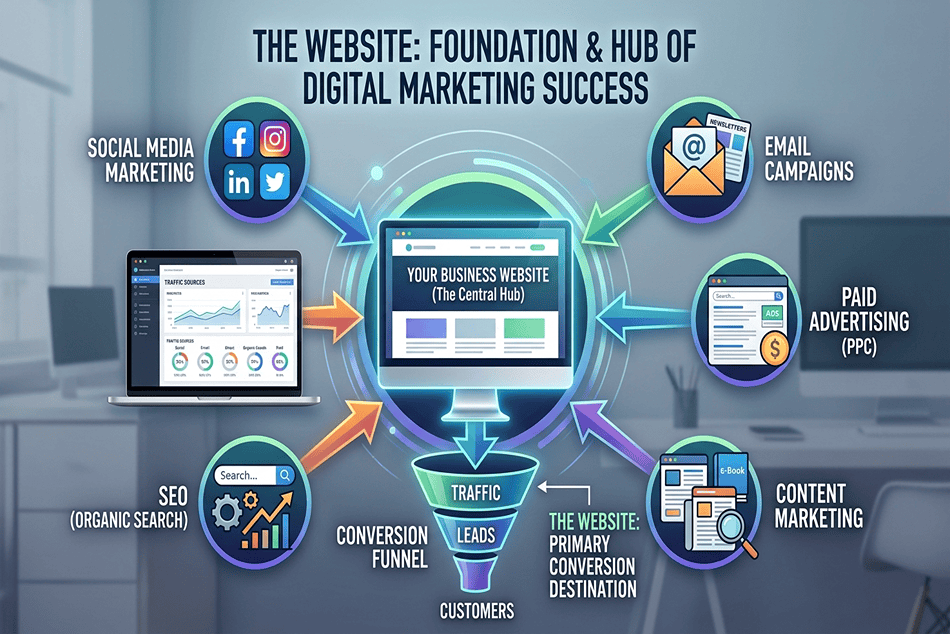
Picture digital marketing as a wheel. The spokes – SEO, PPC, social media, email, video – generate traffic. But all of them lead to the center, the website. And it’s at the center that conversion happens: the purchase, the request, the call, the subscription. This framework, which we call the Digital Marketing Hub Model, explains why investing in the site determines the effectiveness of every other channel.
| Spoke (channel) | What it generates | Leads to |
|---|---|---|
| SEO | 53% of web traffic | Pages on the site |
| PPC | Fast paid traffic | Landing pages |
| Social Media | Attention, engagement | Links to the site |
| Highest ROI ($36/$1) | Product/promo pages | |
| Content | Organic traffic, authority | The site’s blog |
| Video | 34% higher conversion | Embedded on the site |
| 🎯 CENTER: Website | CONVERSION | Customer |
The principle of the model: every spoke generates traffic, but conversion happens at the center. If the center (the website) is slow, confusing, or unprofessional, every spoke works with limited potential. Specifically: every additional second of delay increases bounce rate by up to 32%; 48% of consumers judge a business’s credibility by the site’s visual appearance; the average conversion rate is 2.3%, but the top 10% of sites reach over 11%.
Applying the model: before investing in the spokes (advertising channels), make sure the center converts. Every euro spent on advertising multiplies if the site converts well, and is lost if it doesn’t. That’s why website development isn’t a marketing expense, but an infrastructure investment that determines the effectiveness of everything else.
The main channels of digital marketing
SEO – search engine optimization
SEO (Search Engine Optimization) is the process of optimizing a website to rank higher in Google’s organic results. Organic search generates 53% of all web traffic and is the channel with the highest long-term ROI, averaging $22 for every $1 invested. SEO leads convert at 14.6%, compared to 1.7% for outbound marketing. The official optimization guidelines are documented at Google Search Central.
SEO covers three areas: technical SEO (speed, mobile optimization, indexing, schema markup), on-page SEO (content, keywords, meta tags, internal links), and off-page SEO (backlinks, brand mentions). All three areas depend on the website. We cover what SEO is and how it works in detail in our central SEO article, and the approach to SEO web design integrates these requirements from day one.
PPC – paid advertising
PPC (Pay-Per-Click) is a model where you pay for every click on your ad, most commonly in Google Ads or on social media. Global PPC spending reaches $306 billion in 2026. The average conversion rate for Google Search Ads is around 4.8%, and the average cost per click ranges from $1 to $5 depending on the industry.
PPC offers fast results – the ad starts generating traffic within the first hour. But the traffic stops the moment you stop paying. And here’s the key dependency: every paid click sends the user to a landing page on your site. If that page is slow, confusing, or unconvincing, the money for the click is wasted. The quality of the landing page also directly affects the Quality Score in Google Ads, which determines how much you pay per click.
Content Marketing – marketing through content

Content marketing is creating and distributing useful, relevant content – articles, guides, videos, infographics – to attract and retain an audience. Content over 3,000 words generates 3 times more traffic and 4 times more shares than shorter content. 82% of marketers actively invest in content marketing.
Where does this content live? On your website. The blog is the main content marketing tool and, at the same time, an SEO engine. Every quality article is a new page that can rank for new keywords. The quality of this content depends on SEO copywriting, and its structure on keyword research. With no website, content marketing is reduced to posts on someone else’s platforms, where algorithms control who sees your content.
Social Media Marketing
Social media is a channel for building community, awareness, and engagement. Social media ad budgets reach $276 billion in 2026, with an average ROI of $5.20 for every $1 invested. Facebook, Instagram, LinkedIn, TikTok, and YouTube each have their own audience and format.
But social media isn’t yours. An algorithm change can cut your visibility by 50% in a single day. That’s why social media is a spoke of the wheel, not the center. It generates attention and traffic that needs to be directed to your site, the platform you fully control. There, the visitor can browse services, read reviews, fill out a form, make a call.
Email Marketing – the direct channel with the highest ROI
Email marketing is the channel with the highest ROI in digital marketing, $36 for every $1 invested – a 3,600% return. Email conversion is high, and segmentation and personalization increase it further.
Email marketing depends on the website in two ways. First, subscribers are collected through the site – signup forms, lead magnets, pop-ups. Second, every email contains links that lead back to the site. We cover building this system in detail in the guide to email marketing and automation, and for collecting subscribers, in the article on lead generation.
Video Marketing – the growing format
Video advertising accounts for 38% of all digital ad budgets, and video campaigns generate 34% higher conversion than static ads. YouTube is the second-largest search engine in the world.
Video is a powerful format for grabbing attention, but the conversion rarely happens within the video itself – it happens on the website the video directs to. A product video on an e-commerce site, embedded on the product page, increases conversion; the same video, published only on YouTube with no link to an optimized site, generates views, not sales.
What makes a website an effective marketing hub
This wheel analogy isn’t abstract – it’s backed by data. 53% of all web traffic comes from organic search and lands on the website. PPC ads send users to landing pages. Social media posts contain links to the site. Emails direct to product pages. Even a Google Maps profile generates 37% of its actions as clicks to the website.
Load speed
70% of consumers acknowledge speed’s influence on the purchase decision. Google uses Core Web Vitals (LCP < 2.5s, INP < 200ms, CLS < 0.1) as ranking factors. A slow site doesn’t just lose visitors – it also pays more for PPC advertising, because the Quality Score in Google Ads drops. Quality hosting with European infrastructure, optimized images, and minified code are the technical foundation for speed.
Mobile optimization
Over 60% of web traffic comes from mobile devices, and Google uses mobile-first indexing. For digital marketing, this means: if your ad is perfect, but the site doesn’t work on a phone, you’re losing the majority of potential customers. Responsive website design, built on the mobile-first principle, ensures marketing traffic is met properly on every device.
CTA and UX design for conversion
The visitor is on the site, and now? With no clear CTA (Call-to-Action), clear navigation, and logical user path, they leave with no action. Personalized CTAs increase conversion by 202%. Well-designed UX design reduces bounce rate and increases engagement time. Conversion rate optimization tests and improves every step of the user journey.
Analytics tools – marketing’s measurability
One of digital marketing’s biggest advantages is measurability. But measurability requires properly configured tools. Google Analytics 4 with event tracking shows what users do on the site. Google Search Console reveals which searches they come from. Google Tag Manager connects marketing channels with conversions. With no data, marketing is a guess, not a strategy.
Digital marketing examples: the channels in action

To illustrate how channels work together and always lead back to the site, here are three concrete examples.
Example 1: A local business (a dental practice). A prospective patient searches “dentist [city]” on Google. The organic result (SEO) or the Google Maps profile directs them to the site. On the site, they see services, prices, reviews, and a “Book an appointment” CTA. They fill out the form. The conversion happened on the website. With no site, or a bad site, the patient chooses the competitor.
Example 2: An e-commerce store. The user sees an ad on Instagram (social media). They click and land on the product page of an online store. They browse the product, read the description and reviews, add it to the cart, buy. The ad generated the click, but the purchase happened on the site. If the site is slow or the product page unconvincing, the ad budget is wasted.
Example 3: A B2B service (a consulting firm). The prospect receives an email with a link to a useful article on the company’s blog (email + content marketing). They read the article, are impressed by the expertise, click an internal link to the services page, fill out a contact form. SEO got the article to rank; the email brought the specific user; but the conversion, again, happened on the website.
In each of these scenarios, the digital channels are the spokes, and the website is the hub.
A strategic digital marketing plan: where to start
Step 1 – Define your business goals. Before choosing channels and budgets, answer clearly: what’s the desired result? More sales? More inquiries? Greater brand awareness? The goals determine the channels, metrics, and budget.
Step 2 – Analyze your target audience. Who is your customer? Where do they look for information – Google, Instagram, LinkedIn? What questions do they ask? What stage of the purchase decision are they at? Keyword research is the tool that reveals the exact phrases used by your audience.
Step 3 – Build the technical foundation (the website). Before investing in advertising, make sure the hub is ready. A fast, mobile-optimized website with clear navigation, convincing content, CTAs, contact forms, and configured analytics tools. If you build on an unstable foundation, no amount of ad spend can compensate.
Step 4 – Choose channels and allocate the budget. You don’t need to be everywhere. It’s better to master 2-3 channels than to have a weak presence in 7. For most businesses in Bulgaria, the effective starting mix is SEO (a long-term investment) + 1 paid channel (Google Ads for transactional queries, or Facebook/Instagram Ads for visual products) + email marketing (for customer retention).
ROI data helps with allocation: Email ($36 per $1), SEO ($22 per $1), Social Media ($5.20 per $1), PPC ($2 per $1). PPC is fast but expensive; SEO is slow but the most cost-effective long-term; Email is cheap and effective, but requires a built-up base.
Step 5 – Measure, analyze, optimize. Digital marketing is a continuous cycle: execute, measure, analyze, improve, repeat. Key metrics include traffic by channel, conversion, cost of acquisition, and ROI. Without properly configured Google tools, these metrics stay invisible – more detail in the guide to marketing metrics.
Digital marketing in Bulgaria: the context
The Bulgarian e-commerce market is growing rapidly, with projections for 2026 at €3.57 billion, driven by growing internet and smartphone penetration. 67% of the Bulgarian population uses social media. Digitalization among small and medium businesses is accelerating, but a significant share of companies still have no functional website, or invest in advertising with no optimized landing page.
This is both a challenge and an opportunity. Businesses that invest now in the right technical foundation – a professional site, configured analytics tools, basic SEO – will have a significant advantage over competitors who keep spending on ads that lead to unoptimized web presences. A clear picture of the cost of a WordPress site also helps get this process started.
Common digital marketing mistakes
Investing in advertising with no optimized site is the most common – you’re throwing money at traffic that doesn’t convert.
No analytics tools means you don’t know what’s working and what isn’t.
Spreading the budget across too many channels at once leads to a weak presence everywhere, and strong nowhere.
Lack of mobile optimization is an expensive mistake, when 60+% of traffic is mobile.
Ignoring SEO in favor of paid advertising alone creates dependency – the moment you stop paying, the traffic stops.
Neglecting email marketing means missing out on the channel with the highest ROI. And perhaps the most expensive mistake of all is treating the website as a “business card,” rather than a business tool.
A professional website analysis pinpoints exactly which of these problems affect your business and offers a prioritized plan for fixing them.
Digital marketing trends for 2026
AI is transforming digital marketing, from automated content creation to AI-powered ad campaigns and AI Overviews in Google, which are changing how users find information. 43% of searches already trigger AI summaries, which reduces organic clicks but increases the value of every click that still happens – a topic we also cover in website ranking on Google.
Personalization is the other mega-trend – 75% of consumers are more likely to buy from brands that offer a personalized experience. Video marketing keeps growing (38% of digital ad budgets). Voice search is gaining momentum, with 76% of voice searches being local – more detail in the article on voice search and SEO.
The common denominator across all trends: they increase the website’s importance. AI Overviews make every click more valuable, which requires higher conversion. Personalization requires technical capability on the site. Video marketing requires a fast site with embedded video. Voice search requires schema markup and local optimization.
CreateWeb’s role: the technical foundation for your marketing
Our team builds the infrastructure marketing runs on – or fails on – the website.
In website development, we integrate every element that turns a site into an effective marketing hub: SEO architecture with keyword research, optimized URLs, meta tags, and heading hierarchy; design with visual hierarchy, readable typography, CTA placement, and mobile adaptation; a technical foundation with Core Web Vitals optimization, quality hosting, and schema markup; Google tools (GA4, Search Console, Tag Manager) for full measurability; and ongoing maintenance, which ensures the site stays fast, secure, and current.
The result is a site ready to receive traffic from every marketing channel and turn it into a real business outcome. Because in digital marketing, the winner isn’t the one who spends the most on advertising – it’s the one whose hub converts most effectively.
Discuss your project with us for a free consultation, or take a look at our portfolio to see how the approach works in practice.
Frequently asked questions
What is digital marketing, in simple terms?
Digital marketing is promoting products, services, or brands through online channels – search engines, social media, email, content, and paid advertising. Unlike traditional marketing, digital marketing allows precise targeting, real-time measurement of results, and budget optimization.
What are the main channels of digital marketing?
SEO (53% of all web traffic), PPC advertising (Google Ads, Facebook Ads), content marketing (articles, guides, videos), social media marketing (Facebook, Instagram, LinkedIn, TikTok), email marketing (ROI $36 per $1), and video marketing (38% of ad budgets). All channels bring traffic to the website, where conversion happens.
What is the Digital Marketing Hub Model?
It’s a framework presenting digital marketing as a wheel: the spokes (SEO, PPC, social media, email, content, video) generate traffic, and the center (the website) is where conversion happens. The principle: every spoke works with limited potential if the center doesn’t convert. Application: before investing in advertising channels, make sure the site is fast, mobile-optimized, and designed for conversion.
Why is the website the center of digital marketing?
Every digital channel – advertising, social media, email, SEO – ultimately sends the user to the website for conversion. If the site is slow, confusing, or unoptimized, the marketing investment is lost. The website is the hub where all channels meet and generate a real business result.
How much does digital marketing cost?
The investment ranges from hundreds to thousands monthly, depending on the channels and scale. SEO generates an ROI of $22 per $1, email $36 per $1, PPC $2 per $1. What matters isn’t the amount, but whether the website is ready to convert the traffic marketing generates.
How do I create a strategic digital marketing plan?
Five steps: define your business goals; analyze your target audience; build the technical foundation (a fast, optimized website with analytics tools); choose 2-3 channels to start (SEO + 1 paid channel + email); measure and optimize continuously.
How does CreateWeb help with digital marketing?
We build the technical infrastructure marketing runs on – the website. This includes SEO architecture, UX design for conversion, mobile optimization, setting up Google Analytics 4 and Search Console, schema markup, and ongoing maintenance. With no this foundation, every marketing campaign works with limited potential.
Conclusion: marketing is only as strong as its hub
Digital marketing in 2026 offers unprecedented opportunities, but behind every channel lies one truth: they all lead to one place, your website. And that’s where it’s decided whether the investment pays off.
The Digital Marketing Hub Model from this article gives a clear picture: the spokes (SEO, PPC, social, email, content, video) generate traffic, and the center (the website) converts. The principle: every euro spent on advertising multiplies if the site converts well, and is lost if it doesn’t. That’s why the site’s technical and design foundation isn’t an expense, but an infrastructure investment.
The strategic approach is clear: define your goals, know your audience, build a stable hub (the site), choose 2-3 channels, and measure continuously. In digital marketing, the winner isn’t the one who spends the most on advertising – it’s the one whose hub converts most effectively.
Want a website that turns marketing traffic into real customers? Write to us for a specific assessment, for a free consultation. We’ll build the hub that makes every one of your marketing channels more effective.
For related specialized resources: our central SEO article, email marketing and automation, lead generation, conversion rate optimization, SEO copywriting, website ranking on Google, Google Maps registration, marketing metrics, keyword research, SEO web design, Core Web Vitals, Google Analytics 4, UI and UX design, what makes a landing page good, an online store with WooCommerce, voice search and SEO, the cost of a WordPress site, website development, website maintenance.
If you want this done by a team, see our CRO conversion rate optimization.
————————–Hj7lv8GOL1k6EsxAGIrgET–