
Публикувано: Обновено:
————————–zB6UxYBspGBVXSA6FffLUc Content-Disposition: form-data; name=”file”; filename=”en10174.html” Content-Type: text/htmlYour site’s position in Google determines how many users will find it, and how many will choose your competitor instead. The 2026 data is telling: the first organic result gets an average of 39.8% of all clicks, while fewer than 1% of users reach the second page of results. At the same time, over 64% of searches end with no click at all, and Google’s AI Overviews now appear on nearly half of all queries. This means competition for visibility has never been fiercer, and understanding website ranking factors isn’t just useful, it’s critical for the survival of any online business.
In this guide, the CreateWeb team covers which signals actually move rankings in Google, how to check your site’s ranking with the right tools, which technical and content optimizations to prioritize, and how to build a sustainable SEO strategy. This is a practical ranking manual that complements our central article on what SEO is, focused specifically on ranking factors and checking results. We’ll also introduce the Ranking Signal Hierarchy, a framework that prioritizes ranking signals by weight.
How ranking in Google works: the basic mechanism

Google uses more than 200 signals in its ranking algorithm, but not all of them carry equal weight. In March 2026, another Google core update reinforced a trend that’s been shaping up for several years: rankings are increasingly determined by a page’s comparative value against competing results for a given query. In practice, Google asks the question “Which of these pages best serves this specific user intent?” and ranks the results by that criterion.
The process runs in three stages. First, Googlebot crawls pages, following links and using the XML sitemap. Second, the content gets indexed – Google analyzes the text, images, structured data, and technical signals to understand what the page is about. Third, at every user search, the algorithm compares indexed pages and orders results by relevance, quality, and authority. We cover this technical process in detail in the guide on technical SEO.
Understanding this mechanism is fundamental, because every optimization boils down to one thing: making your page more understandable, more useful, and more authoritative in Google’s eyes than the other results for the same query. The official documentation at Google Search Central is the primary source for all these principles.
The Ranking Signal Hierarchy: prioritizing ranking factors
One of the most common SEO mistakes is treating all ranking factors as equally important – endless hours spent on minor technical settings, while content remains mediocre. The reality is that signals carry different weight. This framework, which we call the Ranking Signal Hierarchy, prioritizes factors by their actual influence on rankings.
| Level | Signal | Weight | Where to dig deeper |
|---|---|---|---|
| 1 (foundation) | Content & Search Intent | Highest | keyword research |
| 2 | E-E-A-T (experience, authority, trust) | Very high | E-E-A-T for WordPress |
| 3 | Technical Foundation (CWV, indexing) | High | technical SEO |
| 4 | Authority (backlinks, topical authority) | High | link building |
| 5 | User Signals (CTR, dwell time) | Medium (indirect) | on-page SEO |
The principle of the hierarchy: you start from the top. A perfect technical site (Level 3) with mediocre content (Level 1) won’t rank, because the foundation is missing. Conversely, exceptional content on a slow site loses positions, but has potential that technical optimization can unlock. Prioritize by weight: first content and intent, then E-E-A-T, then the technical foundation, then authority, and finally the finer user signals.
Applying the framework: audit your site level by level. Does the content serve the intent? Does it demonstrate E-E-A-T? Does it cover Core Web Vitals? Does it have a quality link profile? Only once the upper levels are solved does investing in the lower ones pay off.
Level 1 – Content quality and Search Intent
Content quality remains the most fundamental ranking factor. Google doesn’t just look for pages containing certain keywords – it evaluates how well the content serves the specific intent behind the search (search intent). The four types of intent – informational, navigational, commercial, and transactional – require different formats and approaches.
The practical significance is direct: if a user searches “website ranking in google,” they expect a detailed explanation of the factors and steps, not a product page. If they search “check website ranking,” they’re looking for a tool or instructions. Content that doesn’t match the intent has no chance of ranking, no matter how well it’s technically optimized. We cover matching content to search intent in detail in the keyword research guide.
Uniqueness and depth are the other two critical elements. Google increasingly and aggressively filters out thin, repetitive, or generated content with no added value. A Backlinko study confirms that the average length of pages ranking in position one is significantly over 1,500 words, not because length itself is a factor, but because in-depth material usually covers the topic more comprehensively.
Level 2 – E-E-A-T: experience, expertise, authoritativeness, trust
The E-E-A-T framework (Experience, Expertise, Authoritativeness, Trustworthiness) is one of the central elements of Google’s quality guidelines, and its importance for ranking keeps growing. In 2026, numerous analyses identify E-E-A-T as one of the most important factors in the algorithm, especially after the December 2025 core update.
In practice, E-E-A-T means Google evaluates whether the author or organization behind the content has real experience with the topic (Experience), whether they possess the necessary expert knowledge (Expertise), whether they’re recognized in their field (Authoritativeness), and whether the site can be trusted (Trustworthiness). This is especially critical for YMYL (Your Money or Your Life) topics – finance, health, legal matters – but applies to all categories.
Since E-E-A-T is a broad topic, here we mark only the essentials – we have a detailed guide with steps for building each of the four pillars in our dedicated E-E-A-T article. In brief: publish content from identifiable authors with bios; show real experience through case studies and a portfolio; build citations from authoritative sources; provide clear contact information.
Level 3 – Technical foundation: Core Web Vitals and health
Core Web Vitals are the specific, measurable metrics through which Google assesses the user experience at a technical level. After the December 2025 update, Google tightened the thresholds. The three metrics are LCP (under 2.5 seconds), INP (under 200 ms), and CLS (under 0.1). A critical fact: only 33% of websites pass all three metrics at once, which represents a huge opportunity – if your site covers every threshold, you have a technical edge over two-thirds of your competitors.
We have a detailed technical analysis of the three metrics and how to optimize them in the Core Web Vitals guide, and for the overall technical foundation (indexing, sitemap, robots.txt, canonical, HTTPS) in the article on technical SEO.
Mobile optimization is an integral part of the technical foundation. Google officially uses mobile-first indexing – your site’s mobile version is the one that gets indexed and evaluated. With over 60% of global web traffic coming from mobile devices in 2026, mobile optimization isn’t an option, but a ranking requirement. Every website design from our team is built on the mobile-first principle.
Level 4 – Authority: backlinks and topical authority
Backlinks remain a top-3 ranking factor in 2026 too. Backlinko’s analysis confirms that Domain Rating (a measure of domain authority) correlates strongly with higher rankings. The key principle is quality over quantity – one link from an authoritative, topically relevant site carries more value than dozens of links from low-quality domains. Low-quality backlinks don’t just fail to help – they can actively hurt.
We have a detailed strategy for building a quality link profile in our dedicated link building guide. Here we only highlight the growing importance of topical authority: Google and AI platforms assess how thoroughly a site covers a given topic. A blog with 50 interconnected articles on a given topic will rank better than a site with 5 unrelated posts, even if the latter has more backlinks. That’s why consistent publishing, organized into topic clusters, is an investment in long-term ranking, exactly the approach we apply in SEO web design.
Brand signals – searches by brand name, mentions (even with no link), social presence, and reviews – round out the picture. Google increasingly recognizes and rewards real, recognizable brands.
Level 5 – User signals and structured data
Although Google denies that bounce rate and dwell time are direct ranking factors, leaked documents from 2024 revealed that Google monitors user signals more closely than it publicly admits. In practice, SERP CTR, dwell time, scroll depth, and repeat visits are indicators the algorithm takes into account – if not directly, then through correlation with quality.
What this means for you: create content that keeps users engaged, gives a quick answer to the main question right at the start, and offers sufficient depth. Optimize your meta title and description for maximum CTR – we cover these on-page elements in detail in the on-page SEO guide.
Structured data (schema markup) isn’t a direct ranking factor, but its influence on visibility is significant. Products with complete schema markup are 4.2 times more likely to appear in Google Shopping. Schema increases the chance of rich snippets (star ratings, prices, FAQ sections), which boost CTR. BrightEdge found that pages with well-structured data receive higher citation rates in AI Overviews. The most important types are Article, FAQPage, LocalBusiness, Product, and Review, and for WordPress, plugins like Rank Math make implementation easier – more detail in the article on SEO plugins.
How to check your site’s ranking: tools and approaches
Systematic ranking checks are essential for any SEO strategy. With no data on current positions, you can’t assess the effect of your optimizations or identify problems in time. This is the aspect most site owners skip, which is why we give it special attention.
Google Search Console – the free foundation
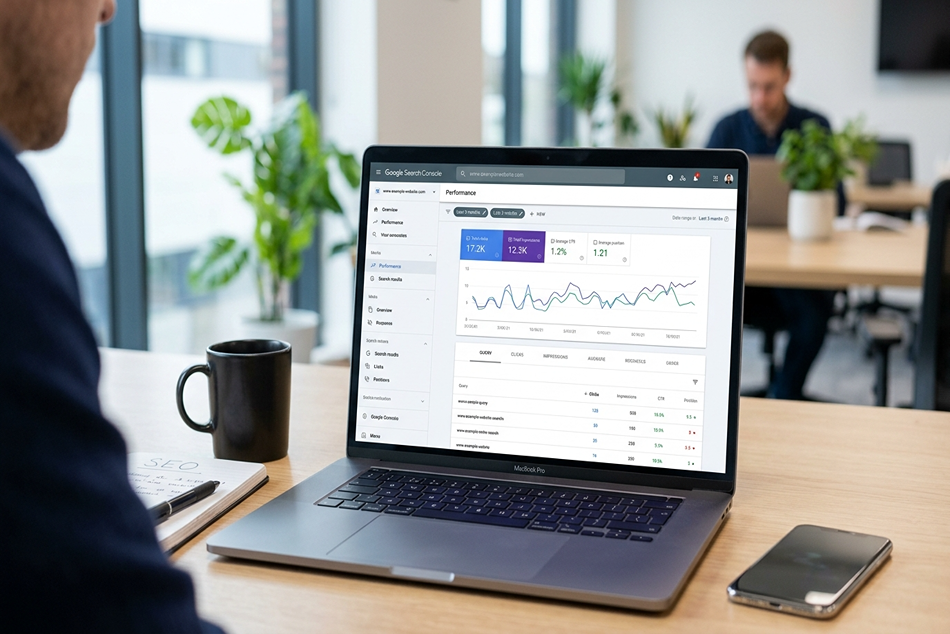
Google Search Console (GSC) is the most accurate free tool for checking rankings, because the data comes directly from Google. After verifying your domain, you get access to average position by keyword, clicks, impressions, and CTR. The “Performance” tab shows this data for every query and page, with filtering by device, country, and period. The “Page Indexing” tab reveals indexing issues, and “Core Web Vitals” shows technical performance.
A practical tip: set up a weekly email report from GSC and track trends in the average position of your top keywords. A sudden drop can signal a technical error, an algorithm change, or lost backlinks.
Additional monitoring tools
For deeper analysis beyond the free GSC, several categories of tools exist. Paid rank trackers like Ahrefs Rank Tracker, SE Ranking, and Mangools’ SERPWatcher offer daily position tracking, competitor analysis, and historical data. Backlinko’s research on millions of search results is a reference source for the correlation between various factors and rankings. Free online checkers like Seobility Rank Check allow a quick check of positions for a specific keyword. For visualization, Looker Studio (formerly Google Data Studio) integrates data from GSC and Google Analytics into custom dashboards.
The choice of tool depends on scale: for a small business with 20-50 keywords, GSC plus a free checker is enough; for agencies and larger projects, a paid rank tracker pays for itself quickly. We have a comprehensive review of website analysis tools in a dedicated article.
How often to check rankings
Checking frequency depends on the project’s stage. A new site or an active SEO campaign requires a weekly review, because changes are frequent and a fast response to a drop is critical. An established site with stable rankings can be checked monthly for top keywords, with a more detailed quarterly audit.
What matters isn’t the frequency itself, but tracking trends, not individual numbers. A keyword can move by a few positions day-to-day due to personalization, location, and AI Overviews – that’s normal noise. A worrying signal is a sustained downward trend over 2-3 weeks, which often coincides with an algorithm change, a technical error, or lost important backlinks. That’s why baseline metrics (average position, clicks, impressions at the start of a period) are more valuable than a single snapshot.
Google Analytics 4 – user behavior
While GSC shows how users find your site, Google Analytics 4 reveals what they do once they arrive. Average engagement time, engaged sessions, conversion events – all these metrics complement the picture from GSC and help you understand not just how much traffic you get, but whether it’s quality traffic.
AI Overviews and the future of ranking

One of the most significant factors changing the SEO ranking landscape in 2026 is AI Overviews (formerly Search Generative Experiences). Data from BrightEdge shows a 58% increase in AI Overviews’ appearance compared to the previous year, now triggered by 25-48% of all searches.
The impact on organic traffic is serious: organic CTR drops by up to 61% for queries where an AI Overview is present. The page in position #1 loses an average of 34.5% of clicks. About 26% of users end their session immediately after reading the AI answer.
But the picture isn’t one-sided. Sites cited in an AI Overview get increased visibility and a new type of traffic. About 43% of citations in AI Overviews link back to Google, and nearly 30% of mentions are from top-50 domains. The key to adapting is: create content in an “answer-first” format, a clear, structured answer at the start, followed by a thorough explanation; use schema markup, especially FAQPage and HowTo; build topical authority through clusters; and strengthen your E-E-A-T signals. This dynamic is closely tied to voice search and optimizing for conversational queries.
Conversion: ranking is a means, not an end
Ranking in position #1 is meaningless if visitors don’t take the desired action. A high position brings traffic, but conversion requires separate optimization: clear CTA buttons, fast and intuitive navigation, convincing content, and a flawless mobile experience. The average conversion rate is 2.3%, and the top 10% of sites achieve over 11% – the difference comes from targeted conversion rate optimization.
For lead-generating businesses, the link between ranking and conversion runs through effective landing pages and a lead generation system. For e-commerce sites, ranking of product pages directly affects sales – more detail in the WooCommerce guide.
Common mistakes that hurt ranking
Even with a good baseline strategy, certain mistakes can seriously hurt rankings. Neglecting the mobile version is fatal – with mobile-first indexing, the desktop site is secondary. Slow loading drives users away before they’ve seen the content. Thin, duplicated, or valueless generated content not only fails to rank, but can bring down rankings for the entire domain. A lack of strategic approach to internal linking leaves authority undistributed. Low-quality or manipulative backlinks risk a manual penalty.
A more subtle, but no less harmful, problem is keyword cannibalization – when two or more pages on a site compete for the same search, Google may rank the weaker one, or neither. The solution is clearly distinguishing target keywords for every page and consolidating overlapping content.
Systematically avoiding these mistakes requires a regular audit. A professional website analysis identifies the specific problems, prioritizes them by severity, and offers a roadmap for fixing them.
Checklist for improving ranking
To sum up practically, here’s a systematic approach along the levels of the Ranking Signal Hierarchy.
Start with the technical foundation (Level 3) – check Core Web Vitals via PageSpeed Insights, ensure HTTPS, submit an XML sitemap in GSC, and check for indexing errors.
Move to on-page optimization (Level 5) – review the meta title and description of every key page, ensure the heading hierarchy (H1 → H2 → H3) is correct, optimize images (alt text, WebP, width/height), and implement schema markup.
Assess your content (Level 1) – does it cover search intent, is it thorough, is it current, and does it demonstrate E-E-A-T (Level 2)?
Strengthen your off-page presence (Level 4) – build quality backlinks, publish consistently in topic clusters, and activate brand signals.
Finally, measure – set up GSC and GA4, establish baseline metrics, and track progress monthly.
If the process feels overwhelming, get in touch with us – our team offers everything from comprehensive SEO web design and website development to ongoing maintenance and optimization.
Frequently asked questions
What are the most important ranking factors for a site in Google in 2026?
The most important factors include quality content aligned with search intent; E-E-A-T (Experience, Expertise, Authoritativeness, Trustworthiness); Core Web Vitals (LCP < 2.5s, INP < 200ms, CLS < 0.1); a quality backlink profile; mobile optimization; structured data (schema markup); and user signals like CTR, dwell time, and scroll depth. The Ranking Signal Hierarchy from this article orders them by weight.
How do I check my site’s ranking in Google?
The free and most accurate tool is Google Search Console – it shows positions, clicks, impressions, and CTR for every keyword. Additional options include Ahrefs Rank Tracker, SE Ranking, Mangools’ SERPWatcher, and free online rank checkers like Seobility. To visualize the data, you can use Looker Studio.
What is the Ranking Signal Hierarchy, and how is it applied?
It’s a framework that prioritizes ranking factors by weight: Level 1 Content & Search Intent (highest), Level 2 E-E-A-T (very high), Level 3 Technical Foundation (high), Level 4 Authority/backlinks (high), and Level 5 User Signals (medium, indirect). The principle: you start from the top – a perfect technical site with mediocre content won’t rank. Application: audit the site level by level and invest in the lower levels only once the upper ones are solved.
What is E-E-A-T, and why does it matter for ranking?
E-E-A-T stands for Experience, Expertise, Authoritativeness, and Trustworthiness. It’s a framework of Google guidelines for assessing quality. In 2026, E-E-A-T is a central element of the algorithms – sites that demonstrate real experience and are backed by authoritative sources rank significantly higher. We have a detailed guide in our dedicated E-E-A-T article.
How long does it take for a new site to rank in Google?
On average, a new site needs 3 to 6 months for low-competition keywords and between 6 and 12 months for medium-competition ones. For highly competitive phrases, the process can take 12+ months. Quality content, a solid technical foundation, and building backlinks speed up the process.
How do Google’s AI Overviews affect ranking and traffic?
AI Overviews appear on 25-48% of searches and reduce organic CTR by up to 61% for informational queries. To adapt, it’s important to optimize for citation in AI answers through structured data, a clear “answer-first” format, thorough expert content, and strong E-E-A-T signals.
How often should I check my site’s ranking?
For a new site or an active SEO campaign, weekly, since changes are frequent. For an established site with stable rankings, monthly for top keywords, with a more detailed quarterly audit. Track trends, not individual numbers – daily fluctuations of 1-2 positions are normal noise, while a sustained downward trend over 2-3 weeks is a sign of a problem.
Conclusion: ranking is a continuous process, not a one-time project
Ranking a site in Google in 2026 is more complex than ever, but the core principles remain clear: create exceptionally useful content for your audience, ensure a flawless technical foundation, build real authority, and measure everything.
The Ranking Signal Hierarchy from this article gives a clear prioritization: Level 1 Content & Search Intent, Level 2 E-E-A-T, Level 3 Technical Foundation, Level 4 Authority, and Level 5 User Signals. The principle: you start from the top, because perfect technical optimization doesn’t compensate for mediocre content. Check your ranking systematically through Google Search Console and track the trends.
With 53% of all web traffic coming from organic search, and SEO-generated leads converting at 14.6% compared to 1.7% for outbound marketing, investing in ranking is one of the most cost-effective marketing strategies. Algorithms will keep changing, AI Overviews will keep spreading, but the sites that sustainably hold top positions are the ones that treat SEO as a continuous process of improvement.
Want a site built for ranking from day 1? Get in touch with us for a free consultation. We’ll apply the Ranking Signal Hierarchy to your site and identify the specific opportunities for improvement. Take a look at our portfolio too.
For related specialized resources: our central SEO article, technical SEO, on-page SEO, E-E-A-T for WordPress, link building strategies, keyword research, Core Web Vitals, voice search and SEO, local SEO, SEO web design, SEO plugins, website analysis tools, Google Analytics 4, conversion rate optimization, lead generation, website development, website maintenance.
Read more: Website Translation. Read more: Google Maps Registration. ————————–zB6UxYBspGBVXSA6FffLUc–