
Публикувано: Обновено:
Marketing has changed fundamentally. The consumer is no longer a passive recipient of ads – they research, compare, read reviews, and control their own path to the final purchase. Despite this transformation, one element remains unshaken at the center: the website. Every channel – SEO, PPC, social media, email, viral marketing – generates traffic that ultimately has to arrive somewhere. Companies with an omnichannel strategy, where the website is the hub, retain 89% of their customers. Those without one, only 33%.
Philip Kotler called this new reality “Marketing 4.0” – the transition from traditional to human-centric digital marketing, where offline and online merge and technology serves human connection. In this article, the CreateWeb team traces the evolution from Marketing 1.0 to 4.0, examines the key online marketing strategies through this lens, and shows why the site is the technological foundation without which none of this works. This is the conceptual layer built on top of our overview of digital marketing and channels.
The evolution: from Marketing 1.0 to 4.0

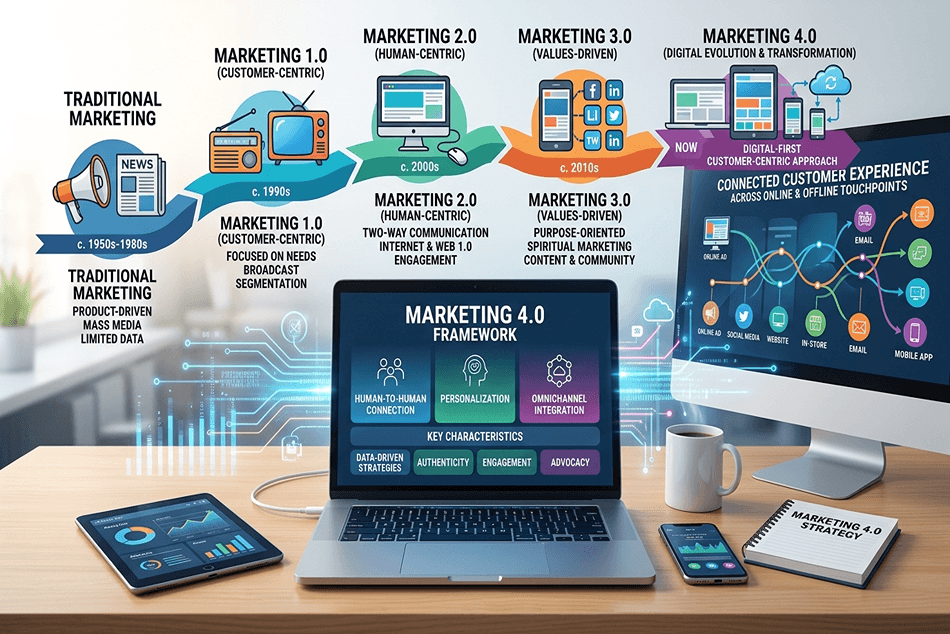
Understanding Marketing 4.0 requires context on where it came from. Philip Kotler, considered the father of modern marketing, describes this evolution in four stages.
Marketing 1.0 – product-focused. The era of mass production. Marketing is one-directional: the company produces, advertises, and sells. The consumer is a passive recipient. Main tools: print ads, radio, television. The message: “Here’s what we make.”
Marketing 2.0 – customer-focused. Competition increases, the consumer gets choice. Marketing shifts toward segmentation, targeting, and positioning. CRM systems and market research emerge. The message: “Here’s what we do for you.”
Marketing 3.0 – values-focused. The consumer is no longer just a buyer, they’re a “whole human being” with values, beliefs, and emotions. Brands that demonstrate authenticity and social responsibility win. 89% of consumers stay loyal to brands whose values they share, and 53% expect brands to take a stance on social issues. The message: “Here’s what we believe.” This stage is closely tied to building a brand and identity.
Marketing 4.0 – human-centric digital marketing. Kotler describes Marketing 4.0 as the merging of online and offline interactions between companies and consumers, combining style and substance in branding, and complementing machine-to-machine connectivity with human-to-human touch (Kotler Marketing Group develops these concepts in detail). The key difference from previous eras: the consumer now controls their own journey. They research on Google, compare on social media, read reviews, click an ad, visit the site, wait for a retargeting email, and only then buy – or don’t.
This evolution isn’t merely an academic taxonomy. It explains why tactics that worked in the 1.0 and 2.0 eras (mass advertising, one-directional messages) lose effectiveness today. The 4.0 consumer doesn’t accept messages passively – they verify, compare, and discuss them with their network. The brands that win aren’t the ones with the biggest ad budget, but the ones that build authentic connection and deliver a seamless experience at every touchpoint – an experience centered on the website.
Kotler’s 5A model: the consumer journey in 4.0
The heart of Marketing 4.0 is the new consumer journey model Kotler calls 5A. It replaces the classic linear funnel (AIDA) with a more realistic, non-linear path reflecting the connected consumer. This framework structures the entire 4.0 logic, and at each of the five stages, the website plays a specific role.
| Stage (5A) | What the consumer does | The website’s role |
|---|---|---|
| Aware | Learns about the brand from an ad, a recommendation, a search | First encounter, design and speed |
| Appeal | Remembers and likes certain brands | Brand projection, visual identity |
| Ask | Researches, compares, reads reviews | Information resource, content, FAQ |
| Act | Buys, requests, contacts | Conversion point, CTA, forms |
| Advocate | Recommends and shares | Review platform, sharing |
The principle of 5A: the journey isn’t linear. The consumer can skip stages, go back, enter Ask multiple times before Act. And at every stage the website is a touchpoint – at Aware and Ask as an information resource, at Act as a conversion point, at Advocate as a review and sharing platform. A break at any stage (a slow site at Aware, confusing information at Ask, a complicated form at Act) breaks the chain.
Applying the model: map your site’s content and functionality against the five stages. Do you have content for Aware (blog, ads)? For Ask (comparisons, reviews, FAQ)? For Act (clear CTAs, easy forms)? For Advocate (a place for reviews, share buttons)? A gap at any stage means lost customers.
A concrete example of how 5A works in practice. A consumer sees an Instagram ad (Aware), visits your site and likes the design and brand tone (Appeal), returns days later to read reviews and comparisons on the blog (Ask), fills out a quote request form (Act), and after good service leaves a review and recommends the business to a colleague (Advocate). Notice: four of the five stages happen on or through the website. That’s the practical reason why Kotler’s 4.0 theory inevitably leads to the same conclusion – the technological core of marketing is the site.
The difference between 5A and the old AIDA funnel (Attention, Interest, Desire, Action) is exactly the Advocate stage. In the connected world of 4.0, the journey doesn’t end with a purchase – the satisfied customer becomes an advocate, whose recommendations drive new Aware cycles for other people. 92% of consumers trust recommendations from people they know more than advertising, which makes Advocate the most valuable, and simultaneously the most neglected, stage.
What online marketing is and how it differs from digital marketing

The terminological distinction matters. Digital marketing is the broader term, covering all marketing activities using digital technologies: digital billboards, SMS, digital TV, as well as internet channels. Online marketing is a subset: marketing strategies and tactics executed entirely through the internet.
In the context of Marketing 4.0, the difference is more academic – for most businesses in Bulgaria, “online marketing” in practice means everything digital, since non-internet channels (digital billboards, SMS marketing) take up a minimal share of the budget.
The essential difference from our article on digital marketing is in the angle: there we covered the channels and the website as a hub; here we build on that with the conceptual framework of Marketing 4.0, omnichannel integration, and the role of data and automation.
Online marketing strategies through the lens of Marketing 4.0
In the 4.0 era, channels don’t work in isolation – they form a system, at the center of which stands the website. Since each of these channels is covered in detail elsewhere, here we present them only through the 4.0 lens, with links to the in-depth guides.
SEO. 53% of all web traffic comes from organic search. In the 4.0 era, SEO is no longer just keywords and backlinks – it’s E-E-A-T, helpful content, Core Web Vitals, and structured data. All of this lives on the website. More detail in our central SEO article and website ranking on Google.
PPC advertising. Google Ads and Meta Ads generate an ROI of around 200%, and 65% of users click on PPC ads with high purchase intent. In the 4.0 context, advertising is an accelerant, not a foundation – it directs targeted traffic to landing pages, whose design and UX determine whether the click turns into a customer.
Content marketing. Generates 3x more leads than outbound at a 62% lower cost. In the 4.0 framework, content is the vehicle for building trust (especially at the Ask stage of 5A), but its “home” is the site. More detail in our content marketing guide.
Email marketing. The highest ROI among all channels, 4,200%. In the 4.0 era, email “nurtures” the consumer between the stages of 5A. More detail in our article on email marketing and automation.
Social media. Budgets reach $276 billion globally. But from the 4.0 perspective, social media is “rented territory” – the algorithm controls reach, the account can be restricted, and the data belongs to the platform. The website is “owned territory,” where you convert social traffic.
Marketing automation. 96% of marketers use or plan to use automation. In the 4.0 era, automation connects the channels: a user visits the site, a cookie identifies them, an email series “nurtures” them, a retargeting ad brings them back, they convert on the site. Without the website as the starting point, automation has no data to work with.
The overall 4.0 principle: the channels are “the spokes of the wheel,” and the website is the hub. Without it, the wheel doesn’t turn – a concept we expand on in our digital marketing model.
Online viral marketing: a realistic look

“Going viral” is every marketer’s dream. The data, however, shows that viral marketing is more of a bonus than a strategy to rely on.
Viral marketing is a strategy where content spreads organically – users share it with their network, generating exponential reach. 92% of consumers trust recommendations from people they know more than advertising, and 71% are more likely to share content that triggers a strong emotion – amazement, joy, surprise.
When it works, the effect is powerful: brand engagement increases by 230% after a viral event, users remember viral content 4x more easily than paid advertising, and brand search volume can spike by 600%.
But 49% of viral moments are accidental, not planned. The average life of a viral campaign is 5-11 days. And 86% of viral sharing is mobile, which means: if your site isn’t mobile-optimized, viral traffic will arrive and leave without converting anything.
That’s why, in the 4.0 logic, viral marketing isn’t a strategy in itself – it’s a potential catalyst whose value is only realized if you have a prepared website with fast loading, a clear CTA, mobile design, and conversion optimization. Without these elements, viral traffic is like rain on concrete – plenty of water, but nothing grows.
Omnichannel and personalization: the heart of Marketing 4.0
If Marketing 4.0 has one core promise, it’s this: a seamless, personalized experience at every touchpoint. Businesses that implement omnichannel strategies retain 89% of their customers, compared to 33% for those with a weak omnichannel connection (data compiled from industry research by platforms like Statista). Omnichannel customers spend 16% more per order and have a 30% higher lifetime value (CLV).
The difference between omnichannel and multichannel is essential. Multichannel simply means presence across many channels, each working in isolation. Omnichannel means the channels are connected into a unified experience: the user starts on their phone, continues on desktop, receives an email, and finishes the purchase, seeing a consistent message everywhere and having their previous actions remembered. This connectivity requires a technological core, and that core is the website with properly set up analytics and integrations.
Personalization is the engine of this difference. 71% of consumers prefer personalized shopping, and 9 out of 10 marketers report increased ROI through personalization. E-commerce platforms with personalization see 20% growth in sales.
In practice, this requires a website that can: collect and process user data (GA4, consent management), show dynamic content based on behavior (returning visitors, source-based messaging), integrate with CRM, email, and ad platforms, and be fast and stable enough to support this functionality without compromising Core Web Vitals.
Our team builds sites with this readiness: integration with Google tools (GA4, GTM, Search Console), an SEO-optimized architecture, fast hosting, and UX designed for conversion. The platform isn’t “just a beautiful site” – it’s the infrastructure on which a 4.0 marketing strategy is built.
The data – the fuel of 4.0 marketing (and why it lives on your site)
Marketing 4.0 is data-driven by definition. Without data, there’s no personalization, no automation, no measurement. And the primary source of first-party data is the website. This is especially important in a post-third-party-cookies world, where owned data becomes ever more valuable.
What a properly configured site collects: traffic by channel (organic, paid, social, email, direct), user behavior (which pages they visit, how much time they spend, where they exit), conversion events (submitted forms, calls, purchases), device and demographic data, and scroll depth and engagement metrics.
This data fuels everything else: which keywords bring leads (for SEO strategy), which ad converts (for PPC optimization), which content engages (for the content calendar), which emails lead to a purchase (for email automation).
42% of marketers can’t prove marketing ROI to leadership. But the ones who can get a 3.1x greater budget increase. The difference isn’t in the channel, but in the measurement infrastructure. That’s exactly why setting up Google tools and website analysis are among the first steps we take. The link between marketing metrics and business results is covered in a separate article.
How CreateWeb builds 4.0-ready websites
Our role is to build and maintain the website – the technological core around which the entire 4.0 marketing system is organized.
What a 4.0-ready site includes: SEO architecture (correct URLs, heading hierarchy, breadcrumbs, internal links, sitemap, robots.txt, schema markup) – everything we cover in the article on SEO and web design. Speed (fast hosting, optimized images, minified CSS/JS, Core Web Vitals in the green zone). Mobile-first design (responsive from pixel one, since over 60% of traffic is mobile). Conversion optimization (CTA buttons, forms, click-to-call, strategic placement). Analytics integration (GA4, GTM, Search Console, consent management, event tracking). Scaling readiness (from a corporate site to an e-commerce platform). Regular maintenance (WordPress/plugin updates, security, backups, monitoring).
If you need branding, copywriting, or marketing strategy, the specialists at wellConnected, the ecosystem CreateWeb is part of, can complete the puzzle.
Common mistakes in online marketing strategies
Investing in channels with no website. Running Google Ads that lead to a Facebook page? Doing SEO with no blog? Sending emails with no landing page? Every channel with no proper endpoint is wasted budget. The average landing page conversion rate is 10.76%, but that requires a professionally built page.
Isolated channels instead of a system. In the 4.0 era, channels need to work together: SEO attracts, content engages, email nurtures, PPC accelerates, and the site converts. When they don’t communicate with each other, effectiveness drops drastically.
Lack of measurement. 61% of marketers struggle to connect metrics with revenue. Without GA4 and Search Console, you don’t know which channel brings customers and which is just “vanity” numbers.
Relying on viral marketing as a core strategy. 49% of viral moments are accidental. Build system-based marketing (SEO + content + email + site) and treat virality as a potential bonus, not a plan.
Neglecting the mobile user. Over 60% of traffic is mobile, 86% of viral sharing is mobile, and 57% of users won’t recommend a brand with a poor mobile site. Mobile-first isn’t an option – it’s a mandatory starting point.
Frequently asked questions
What is Marketing 4.0 according to Kotler?
Marketing 4.0 is Philip Kotler’s concept describing human-centric digital marketing, the merging of online and offline interactions, where technology serves human connection. It’s the fourth stage in the evolution of marketing: 1.0 (product-focused), 2.0 (customer-focused), 3.0 (values-focused), and 4.0 (the connected consumer, controlling their own journey). The key difference: the consumer controls their own path to purchase.
What is the 5A model, and how is it applied?
5A is Kotler’s model for the consumer journey in Marketing 4.0: Aware, Appeal, Ask, Act, and Advocate. It replaces the linear funnel with a non-linear path – the consumer can skip stages and go back. Application: map your site’s content against the five stages and fill the gaps, because a break at any stage breaks the chain.
What’s the difference between online marketing and digital marketing?
Digital marketing is the broader term, covering all digital activities (digital billboards, SMS, digital TV, and internet channels). Online marketing is a subset, executed entirely through the internet. For most businesses in Bulgaria, the difference is academic, since non-internet channels take up a minimal share of the budget.
Why is the website the center of Marketing 4.0?
Because every channel (SEO, PPC, social, email) generates traffic that has to convert somewhere, and that place is the site. Omnichannel businesses retain 89% of their customers versus 33% with a weak connection. The site is also the primary source of first-party data that fuels personalization and automation, the heart of 4.0.
Does viral marketing work as a strategy?
Viral marketing is more of a bonus than a reliable strategy. 49% of viral moments are accidental, and the average life of a viral campaign is 5-11 days. Additionally, 86% of viral sharing is mobile – with no mobile-optimized site, traffic arrives and leaves with no conversion. Build system-based marketing and treat virality as a potential catalyst.
Why is data so important in Marketing 4.0?
Marketing 4.0 is data-driven by definition – without data, there’s no personalization, automation, or measurement. The primary source of first-party data is the website, which collects traffic by channel, behavior, conversion events, and engagement. Marketers who can prove ROI through this data get a 3.1x greater budget increase.
How does CreateWeb help build a 4.0-ready site?
We build the technological core of the 4.0 strategy: SEO architecture, speed (Core Web Vitals), mobile-first design, conversion optimization, analytics integration (GA4, GTM, Search Console), and scaling readiness. For branding, copywriting, or marketing strategy, the specialists at wellConnected complete the puzzle.
Conclusion: Marketing 4.0 isn’t theory – it’s a system with the website at its center
Marketing 4.0 describes the reality businesses now operate in: connected consumers, multiple touchpoints, an expectation of personalization and authenticity. 2026’s online marketing strategies are more effective than ever: SEO generates an ROI of up to $22 per $1, email marketing returns $42 per $1, and automation, $5.44 per $1.
But none of these strategies works without a technological core. The evolution from 1.0 to 4.0 and Kotler’s 5A model (Aware, Appeal, Ask, Act, Advocate) show the same thing: at every stage of the consumer journey, the website is a touchpoint, an information resource, a conversion point, and a platform for recommendations. Omnichannel businesses retain 89% of their customers, and omnichannel is impossible without a stable, fast, and intelligently designed site.
We build exactly such sites – the technological foundation on which your 4.0 marketing strategy can run. Reach out for a consultation with CreateWeb for a free consultation, or take a look at our portfolio.
For related specialized resources: digital marketing and channels, content marketing, email marketing and automation, lead generation, conversion optimization, brand and branding, our central SEO article, website ranking on Google, marketing metrics, SEO web design, Core Web Vitals, Google Analytics 4, what makes a landing page good, website analysis tools, website development, website maintenance.
If you want this done by a team, see our conversion rate optimization service.