Публикувано: Обновено:
————————–VnCXAwVe2Y4I3gf2oPeP3H Content-Disposition: form-data; name=”file”; filename=”en10206.html” Content-Type: text/htmlGoogle doesn’t rank sites, it ranks trust. In 2026, the algorithm may be complex, but its message is simple: show that you know what you’re talking about, that you actually do it, and that people can trust you. The framework Google uses for this assessment is called E-E-A-T, Experience, Expertise, Authoritativeness, Trustworthiness.
This isn’t abstract theory. After the December 2025 core update and the March 2026 one, sites with strong E-E-A-T signals gained 23% more visibility, and content optimized for E-E-A-T gets 28% more visibility long-term (Averi AI, March 2026; WhiteHat SEO/Moz). In the era of AI Overviews, the data is even more clear-cut: sites with established E-E-A-T get 3.5 times more clicks from AI source links (BrandLume, 2026).
In this article the CreateWeb team explains exactly what stands behind each “E” and “T”, how to implement it practically on WordPress, and why a trusted site isn’t just better ranked, but also more convincing to your potential customers. We’ll also introduce the E-E-A-T Trust Pyramid, a 4-tier pyramid framework that reflects Google’s official positioning: Trust is the foundation on which Experience, Expertise, and Authoritativeness stand.
The E-E-A-T Trust Pyramid: a framework with Trust as the foundation
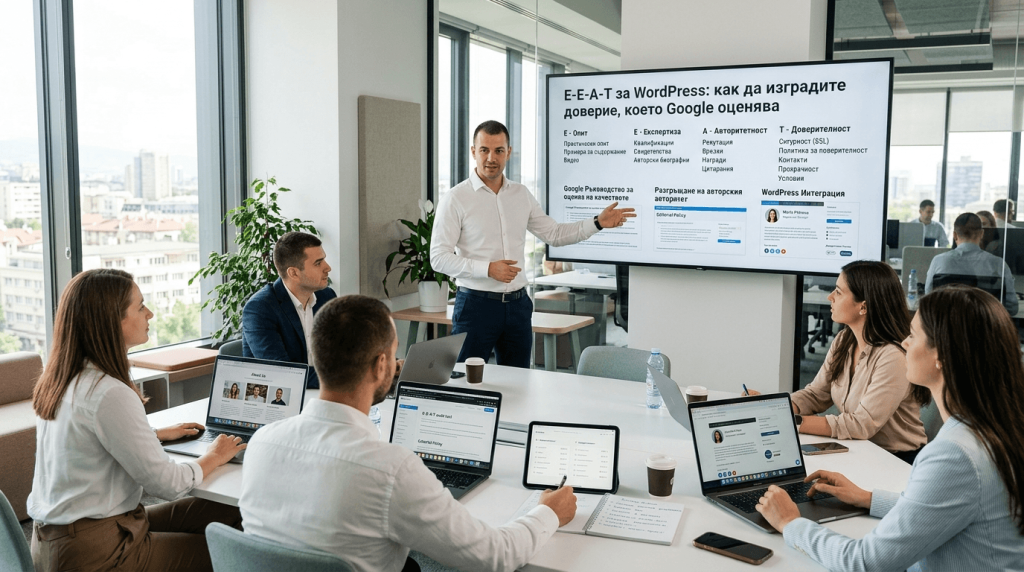
One of the most common mistakes in working with E-E-A-T is treating the four elements as equal. Google is explicit in its official Search Central guide on helpful content: Trustworthiness is the most important pillar. A page can demonstrate experience, expertise, and authoritativeness, but if it’s inaccurate, misleading, or non-transparent, the E-E-A-T assessment will be low, regardless of the other signals (iMarkInfoTech, HM Digital Solution, 2026). This framework, which we call the E-E-A-T Trust Pyramid, reflects exactly that: Trust is the broad foundation on which the other three pillars stand.
| Tier | Pillar | What it covers | Why it’s in this position |
|---|---|---|---|
| Tier 1 (foundation) | Trust | SSL/HTTPS, transparent data, a Privacy Policy, “About Us” | Google’s official positioning: the most important |
| Tier 2 | Experience | First-hand case studies, before/after examples, authorial experience | With no Trust as a base, Experience is an untrustworthy story |
| Tier 3 | Expertise | Authored credentials, technically accurate content, depth | Expertise with no trust = suspicion, expertise with no experience = theory |
| Tier 4 (peak) | Authoritativeness | Backlinks, brand mentions, sameAs, social proof | The external signal that reinforces everything below |
The principle of the pyramid: you start from Tier 1 (Trust). A site with no SSL, no contact information, and no “About Us” page can’t build E-E-A-T, no matter how good its authors are. Every subsequent tier increases the weight of the signal, but only if the foundation is stable. Authoritativeness with no Trust is like a sandcastle, visible, but temporary.
Applying the framework: assess which tier your position is weakest at. Missing Privacy Policy? Tier 1 is the priority. You have solid technical SEO but no authored bios with credentials? Tier 3. You have everything internally, but no one mentions your brand? Tier 4. Moving from one tier to the next brings 15-25% visibility in the current SEO landscape.
Tier 1: Trust – the foundation
Trust at the website level means: clear information about the owner (company or individual), easily accessible contact information, transparent terms of use and a privacy policy, SSL/HTTPS, real customer reviews, and no misleading practices (hidden fees, false promises, clickbait headlines).
The minimal Trust package for WordPress
For a WordPress business site, the minimal Trust package includes: a full “About Us” page with a name, address, team photos, and company history, a contact page with a form, phone, and email, a Privacy Policy and Terms of Service, an SSL certificate (mandatory since 2014, but still missing on old sites), and a Google Business Profile with real reviews.
Contact information and transparency
Google evaluates how easily a user can reach you. A site with no contact form, no phone number, and no physical address radiates anonymity, the opposite of Trust.
The minimum is: a contact page with a form, email, and phone number, a footer with the address and basic details on every page, and Privacy Policy / Terms of Service accessible from the navigation. In our team’s WordPress site builds, these elements are a standard part of every project.
SSL/HTTPS and technical reliability
HTTPS has been a core Trust signal since 2014. But Trust doesn’t end with SSL: a fast-loading site (Core Web Vitals covered), no 404 errors, correct 301 redirects, and a clean technical SEO structure also send reliability signals. We have dedicated guides covering the technical SEO structure and Core Web Vitals optimization in detail.
A user who lands on a slow, “broken” site can’t trust it, and Google reasons the same way. The same applies to web accessibility – a site that doesn’t work for all users doesn’t convey Trust.
Tier 2: Experience – the first-person account
Experience was added to the framework in December 2022 and reflects whether the author has personal, direct experience with the topic. Google wants to distinguish content written by someone who has actually done, seen, or experienced something, from content compiled from secondary sources.
How Experience is demonstrated
For a WordPress web agency, Experience is demonstrated through: case studies from real projects in the portfolio with specific numbers (speed before and after, traffic growth, conversion improvement), screenshots from the work process, specific observations that only someone with hands-on experience could make (“when migrating from Elementor to a block theme, losing inline CSS styles is the most common problem”), and an authorial perspective that can’t be generated by AI.
AI content vs. Experience
This distinction is critical in 2026: after the February core update, Google improved its detection of low-quality AI content with no original experience (PikaSEO, February 2026). AI can be a drafting tool, but Experience only comes from work actually done.
In practice: instead of “Top 10 WordPress themes” (a generic list AI generates in seconds), write “The themes we test on our projects: why we choose Astra for business sites and Kadence for WooCommerce” – with specific observations from practice, speed numbers, and examples from real projects. The approach is similar for blogging for profit – Experience is the difference between an authoritative blog and a compilation.
Tier 3: Expertise – the depth of knowledge
Expertise means the author or organization possesses sufficient knowledge on the topic. For YMYL topics (finance, health, legal matters), Google expects formal qualifications – a degree, certificate, professional license. For non-YMYL topics, like web design, WordPress development, or SEO, Expertise can be demonstrated through years of hands-on experience, a portfolio, and thorough, accurate content.
How Expertise shows up in WordPress
In WordPress, Expertise shows up through: an authored bio with specific qualifications and experience (not “we’re great”, but “10 years of experience with WordPress, over 150 completed projects”), technically accurate content with specific data and sources, topical depth, covering the topic from multiple angles rather than a superficial summary, and internal links to related posts that build topical authority (a topic cluster).
Expertise through content
First-hand experience over compilation is the principle Google clearly confirms. Citing authoritative sources (Google Developers, Semrush, Ahrefs, W3C, official studies) is a direct Expertise signal. When you tie a claim to a specific source, you demonstrate transparency and expertise. Links to external sources don’t “leak” SEO value – they strengthen trust.
In WordPress, external links are added directly in the editor. Good practice is to mark them nofollow only for advertising or sponsored content – for informational and editorial links, normal dofollow is the right approach. We have a separate article covering structured data and on-page optimization that supports the Expertise signal in detail.
Tier 4: Authoritativeness – what others say about you

Authoritativeness is an external signal: how others perceive your brand and your authors. It’s built outside your own site, through backlinks from authoritative sources, brand mentions (mentions of the brand, even with no link), media coverage, professional directories, and social proof.
Brand mentions and backlinks
2026 data shows unlinked brand mentions carry real SEO value – they help Google build the brand’s entity profile and assess its reputation (ClickRank, SearchAtlas, Zumeirah, 2026). This doesn’t mean backlinks don’t matter – 58% of SEO specialists rank them as the most significant ranking factor (SearchLogistics, 2026). But the combination of links and mentions creates the full picture of authoritativeness.
Schema sameAs for the entity profile
For a WordPress site, authoritativeness is also maintained internally: LocalBusiness or Organization schema with sameAs links to social profiles, Google Business Profile, and professional directories. These sameAs links help Google connect your various online presences into a single entity.
Reviews and social proof
Google Business reviews, Trustpilot, Clutch, directory ratings – all of this affects the Trust component and reinforces Authoritativeness. Encourage satisfied customers to leave real reviews. Embed a testimonials section on the site with names and photos (with permission).
E-E-A-T and YMYL: when the standards double
YMYL (Your Money or Your Life) is a category of content that affects a user’s financial well-being, health, safety, or well-being. Google applies significantly higher E-E-A-T standards for YMYL topics.
The category isn’t strictly defined – it’s a spectrum. Obviously YMYL is medical advice, financial services, legal consultations. Less obvious, but also YMYL, is e-commerce (the user spends money), news content (affects public awareness), and even recipes for people with food allergies.
Since the March 2026 core update, E-E-A-T for YMYL topics is no longer a recommendation but a de facto requirement: verified authored credentials, bio pages, and first-hand experience are the baseline for YMYL ranking (LinkedIn/Spencer Robert, March 2026).
Even if your site doesn’t fall into a traditional YMYL category, the “treat your site as YMYL” approach can’t hurt you, and will probably help. For e-commerce projects, YMYL standards are especially critical – product pages on an online store require full coverage of the E-E-A-T Trust Pyramid from day one.
Practical implementation of E-E-A-T in WordPress
The “About Us” page: the storefront of trust
The “About Us” page is the most direct E-E-A-T signal for Google and for users. It should include: the company’s history (when founded, what problems it solves), photos and names of key team members, specific qualifications and experience (years of practice, number of completed projects, certificates), and a clear mission, not marketing jargon, but a specific description of what you do and for whom.
Connect the “About Us” page to Organization schema – Yoast SEO and RankMath generate this automatically when properly configured.
Authored profiles on blog posts
For the blog section, every post should have a visible author with a link to an authored page. The authored page includes: a photo, full name, position at the company, a short bio focused on experience and expertise on the topics they cover, and links to social profiles (LinkedIn is the most significant for professional credibility).
In WordPress, the authored page is automatically generated from the author archive (/author/name/). Yoast SEO and RankMath add Person and ProfilePage schema to it. To add an author bio box under every post, most modern themes already have this functionality built in, and with block themes you can use the “Post Author” block in the template editor. We have a dedicated guide for a comprehensive approach to customizing WordPress with FSE, including author archives.
Schema markup for E-E-A-T
Structured data isn’t a direct ranking factor, but it helps Google understand who’s behind the content, and connect the entities correctly.
The minimal schema package for E-E-A-T in WordPress includes: Organization schema with name, url, logo, contactPoint, sameAs (social profiles, Google Business, directories), Person schema for each author with name, jobTitle, description, sameAs (LinkedIn, Twitter/X, personal site), Article schema with author, datePublished, dateModified, publisher, and ProfilePage schema for the author archives (Yoast generates this from version 22.7+).
For on-page SEO optimization, we additionally add FAQPage and BreadcrumbList schema, which improve rich snippet visibility. This is the Authority Layer of the framework we define in our central article on on-page SEO.
E-E-A-T and content: what “quality” means in 2026
Freshness: publish and update dates
Google values freshness, especially for topics that change fast (technology, SEO, legislation). Every post should have a visible publish date and a last-updated date. In Article schema, the datePublished and dateModified fields reflect these dates.
When you update an old post (adding new data, correcting outdated advice), change dateModified, but don’t falsify datePublished. Google detects and penalizes date manipulation. Regularly updating content is one of the reasons ongoing WordPress site maintenance is a critical part of a long-term SEO strategy.
Design and UX as Trust signals
Trust doesn’t end with content. Clean, user-focused design reinforces trust in the first 50 milliseconds of the user experience. Bad design = a lack of trust, regardless of how good the content is. Similarly, a minimalist approach to visual hierarchy is a direct Trust signal – users intuitively trust clean, purposeful interfaces.
E-E-A-T beyond the site: signals you don’t fully control

Backlinks from authoritative domains
Links from news sites, industry media, professional directories, and university resources are a strong Authoritativeness signal. They aren’t bought – they’re earned through valuable content, original research, guest posts, and PR activities.
Brand mentions
Unlinked mentions of your brand – in articles, forums, social media – also build the entity profile. Google uses these mentions to assess reputation and E-E-A-T (ZentroSEO, ClickRank, SearchAtlas, 2026). Monitor them via Google Alerts or Brand24 and, where possible, convert them into a backlink. We have a dedicated selection for a full review of website analysis and brand monitoring tools.
E-E-A-T and AI Overviews: why trust is the ticket to citation
Google’s AI Overviews aren’t random – they synthesize information from sources the algorithm trusts. Data from 2025-2026 shows a clear pattern: 96% of AI citations come from sources that meet the E-E-A-T criteria (Ziptie.dev). Sites with established E-E-A-T get 3.5 times more clicks from AI source links (BrandLume, 2026).
Optimizing for AI visibility isn’t a separate discipline – it’s a natural extension of the E-E-A-T strategy. A clear heading structure (for easy information extraction by AI), FAQ sections, specific definitions at the start of a paragraph, original data, and authoritative citations – everything that makes your content credible to Google also makes it credible to AI models. We have a dedicated guide covering AI tools for web analysis and their role in modern SEO in detail, and a separate article for voice search and SEO, which follows the same principle.
E-E-A-T checklist for WordPress
The checklist is organized by the 4 tiers of the E-E-A-T Trust Pyramid.
Tier 1 – Trust (foundation). A full “About Us” page. Contact information on every page (footer). Privacy Policy and Terms of Service. SSL/HTTPS. A Google Business Profile with real reviews. A testimonials section. Quality hosting with a fast TTFB.
Tier 2 – Experience. Original case studies in the portfolio with numbers. First-hand observations in blog posts. Process screenshots and before/after comparisons. An authored bio describing hands-on experience.
Tier 3 – Expertise. Authored profiles with qualifications and experience. Technically accurate, thorough content. Topic clusters (pillar + cluster articles). Internal links between related posts.
Tier 4 – Authoritativeness. Organization and Person schema with sameAs. Profiles in professional directories. Monitoring of brand mentions. A backlink acquisition strategy.
Content (cross-cutting). datePublished and dateModified on every post. External links to authoritative sources. Keywords in context, with no stuffing. Original content with added value, not compilation.
Technical foundation (cross-cutting). Core Web Vitals covered. A clean technical SEO structure. Proper on-page optimization. Accessibility for all users per WCAG 2.2. For a full view of measuring results, we have a dedicated guide on marketing metrics.
How E-E-A-T gets built in from the start
E-E-A-T isn’t something “added” to a finished site – it’s built from the very beginning. On every WordPress project, our team implements the baseline E-E-A-T infrastructure: Organization schema with real data, author archives with Person and ProfilePage schema, an “About Us” page with structured content, a contact page with LocalBusiness markup, SSL, fast hosting, and Core Web Vitals covered.
This is the foundation, Tier 1 of the E-E-A-T Trust Pyramid. On top of it, you build with quality content, case studies, authored articles, and external brand building, and the result is a site Google can trust. Building trust is a process, not a one-time action, but with no proper foundation, it’s impossible.
If your current site lacks these elements, talk to the CreateWeb team and let’s build it right. We offer a comprehensive strategy for web design with built-in E-E-A-T as part of our standard process.
Frequently asked questions
What does E-E-A-T mean?
Experience, Expertise, Authoritativeness, and Trustworthiness. The framework Google uses to assess content quality through the Quality Rater Guidelines. Google has declared Trust the most important pillar, which is exactly why in our E-E-A-T Trust Pyramid framework it’s the foundation the other three stand on.
What is the E-E-A-T Trust Pyramid, and how is it applied?
It’s a 4-tier pyramid framework with Tier 1 (Trust) as the base: SSL, contact details, “About Us”, Privacy Policy; Tier 2 (Experience): first-hand case studies and observations; Tier 3 (Expertise): authored credentials and topical depth; Tier 4 (Authoritativeness): backlinks, brand mentions, sameAs. The principle: the pyramid works bottom-up. With no Trust foundation, the upper tiers carry no value. Application: assess which tier you’re weakest at and start there.
Is E-E-A-T a direct ranking factor?
It’s not a single algorithm, but a framework of multiple signals. But the influence is real: sites with strong E-E-A-T signals gained 23% more visibility after the March 2026 update (Averi AI). Content optimized for E-E-A-T gets 28% more visibility long-term (Moz/WhiteHat SEO).
What is YMYL?
Your Money or Your Life – content that affects a user’s financial well-being, health, or safety. For YMYL topics, Google applies significantly higher E-E-A-T standards. Since 2026, verified authored credentials are mandatory for YMYL ranking.
How do I show Experience on WordPress?
Case studies with numbers from the portfolio, before/after comparisons, process screenshots, an authored bio describing hands-on experience. AI can’t replace first-hand experience. This is Tier 2 of the E-E-A-T Trust Pyramid and one of the most measurable ways to stand out from competitors.
Which schema types support E-E-A-T?
Organization (company data, sameAs), Person (authors with credentials, jobTitle, sameAs), ProfilePage (author archives), Article (author, datePublished, dateModified), and LocalBusiness (address, phone, reviews). Yoast and RankMath generate most of these automatically.
Does AI-generated content comply with E-E-A-T?
Google doesn’t penalize AI per se, but low-quality content with no originality and Experience. AI is a drafting tool, but the post needs to be enriched with first-hand expertise and real data.
How does E-E-A-T affect AI Overviews?
Sites with established E-E-A-T get 3.5x more clicks from AI source links (BrandLume, 2026). 96% of AI citations come from sources that meet E-E-A-T. Optimizing for AI visibility runs through trust, authority, and original content.
What’s the relationship between E-E-A-T and on-page SEO?
E-E-A-T is the “Authority Layer” in our 5-layer On-Page SEO Stack framework, but with a comprehensive approach, E-E-A-T is a broader strategy that requires its own pyramid organization. The on-page SEO article covers E-E-A-T as a component of a specific page, this article covers E-E-A-T as a brand-level strategy.
Conclusion: E-E-A-T is a process, not a feature
Google doesn’t rank sites on a single factor, but on the overall picture of trust your online identity builds. The E-E-A-T Trust Pyramid from this article gives a clear structure for systematic work: you start from Tier 1 (Trust, the foundation: SSL, “About Us”, contacts, Privacy Policy), move to Tier 2 (Experience: first-hand case studies), Tier 3 (Expertise: authored credentials, topical depth), and Tier 4 (Authoritativeness: external signals, backlinks, brand mentions).
The principle of the pyramid: every tier depends on the previous one. Authoritativeness with no Trust is like a building with no foundation, visible, but doomed. Expertise with no experience is theory. Experience with no trust is an untrustworthy story. When the 4 tiers work together, the result is a site Google can trust.
The 2026 data confirms its importance: 23% more visibility after the March core update, 28% long-term improvement, 3.5x more clicks from AI Overviews, 96% of AI citations from E-E-A-T-covering sources. In a world where algorithms grow ever more complex, trust remains the simplest and strongest signal.
If you want a WordPress site with E-E-A-T built in from day one, get in touch with the CreateWeb team for a free consultation. We’ll apply the E-E-A-T Trust Pyramid to your specific case and propose a plan that systematically addresses every tier. Take a look at our portfolio for real examples.
For related specialized resources: our central SEO article, technical SEO for WordPress, on-page SEO optimization, SEO web design, Core Web Vitals optimization, voice search and SEO, web accessibility and the EAA, minimalist web design, customizing WordPress with FSE, UI and UX design, WordPress as a platform, quality web hosting, AI tools for web analysis, marketing metrics, blogging for profit, an online store, website development, website maintenance.
————————–VnCXAwVe2Y4I3gf2oPeP3H–